Seeing Appalachia | John Ryan Brubaker

I learned of John Ryan Brubaker's work through a mutual friend, Emma Fisher, Tamarack Artisan Foundation's program director. Before I even saw the work, I was taken by the process of the work. More and more these days, I'm interested in how work is made and after learning that John Ryan used acid mine drainage as a central component of his series 'On Confluence,' I wanted to learn more. John Ryan not only shares images from the series, but also images from the field as the work was made.
(Editor's note: for the last three and a half years, I've written the series titled 'Looking at Appalachia' here on my blog. Since launching the Looking at Appalachia project in February 2014, I've considered renaming this series to create a clear separation between my personal writing and the project. This installment is the first under the new series name 'Seeing Appalachia.' Thanks for reading and for your continued support.)
Now on to John Ryan's work. I asked him to introduce it and talk about his process a bit.

On Confluence Walks down the North Fork
The North Fork Blackwater River runs past Thomas, West Virginia before joining the Blackwater proper in the canyon downstream. Thomas developed as a coal town in the early 20th Century, but as the mines were abandoned they filled with water which continues to drain into the river today. The mine void currently covers 1100 acres and discharges an average of two million gallons of water per day into the North Fork. The drainage has a pH in the 3.0 – 5.0 range and contains heavy concentrations of iron and aluminum. This water dissolves heavy metals and creates acid mine drainage, which is detrimental to river ecosystems, rendering them generally unfit for life, recreation, or consumption.
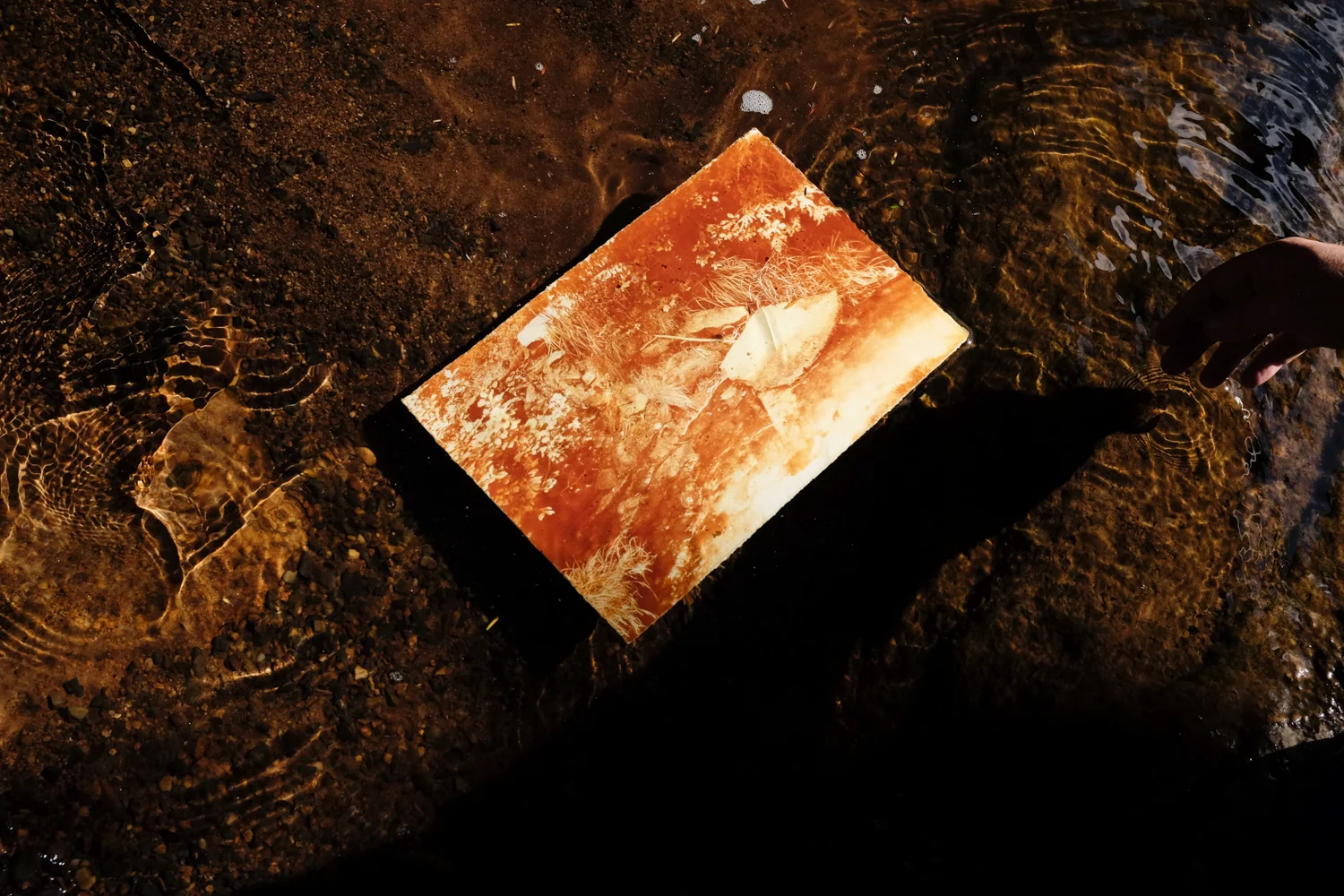
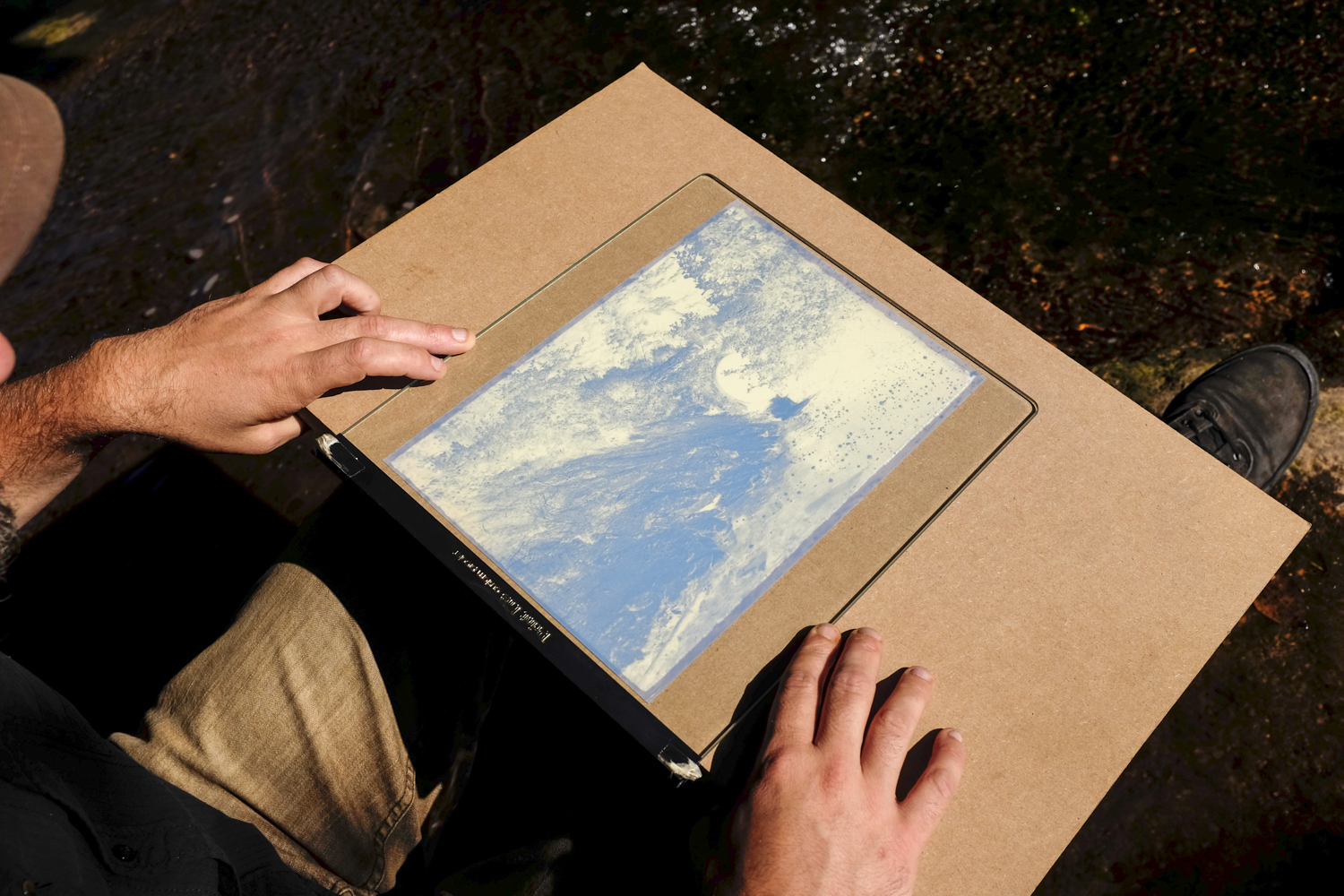
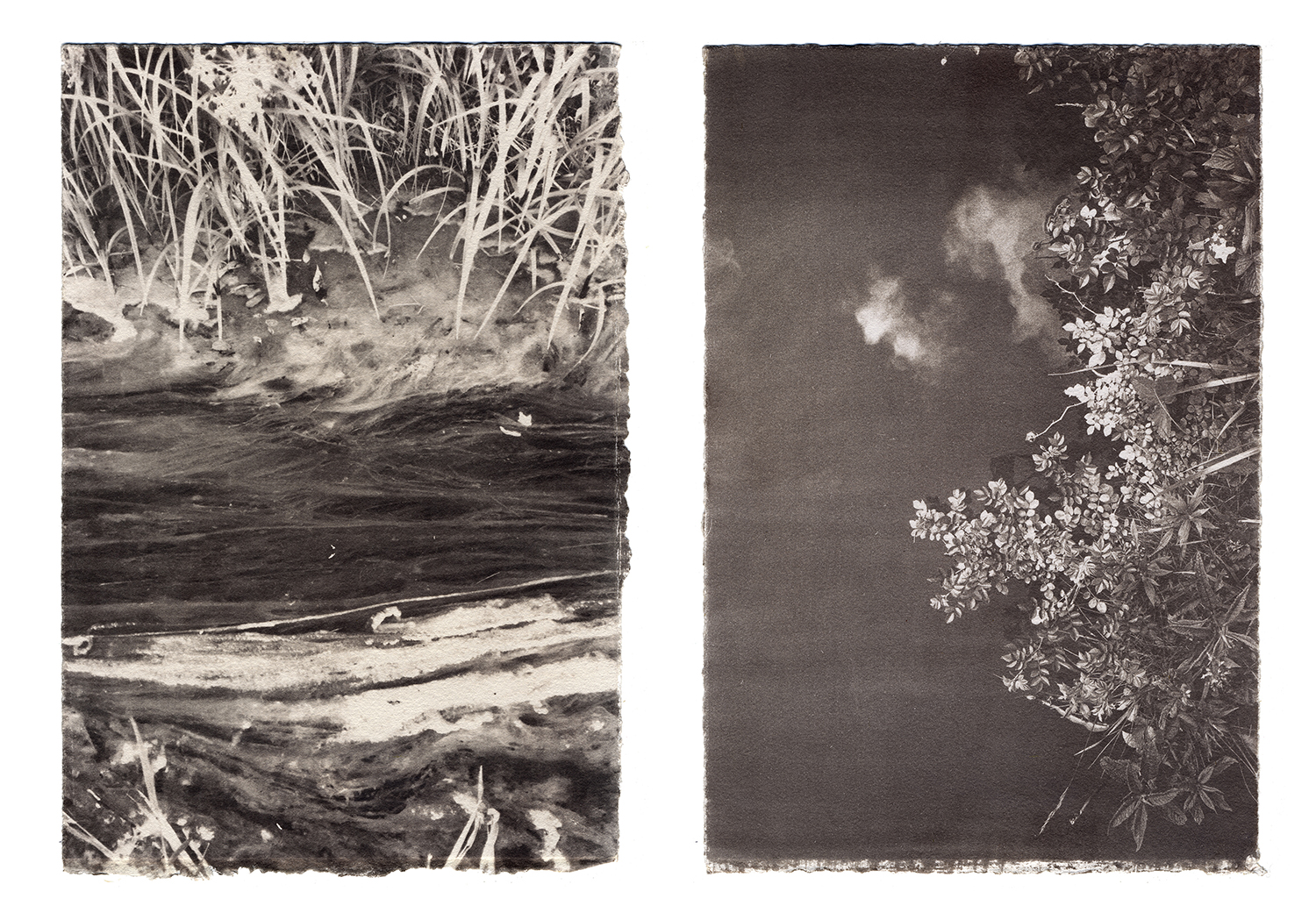
The images in this project were shot during a number of walks in and around the North Fork. As most of the river is difficult to access the process required walking through the riverbed directly. The prints were made using an iron-based photographic process called the Van Dyke Print. This process uses acidic water as its developing agent, making the contaminated portions of the North Fork an ideal location for creating prints.

The works, exhibited earlier this year for the first time at the Carnegie Hall Museum Gallery in Lewisburg, West Virginia, were processed directly in river water effected by acid mine drainage and have absorbed traces of the same heavy metals and mine runoff as the North Fork Watershed itself.

For the past four years I have split my time between the 500-person Appalachian town of Thomas, West Virginia and the million-person city of Brussels, Belgium. During that time the majority of my photographic work was shot and conceptualized in the urban environment and then printed and produced over the summer in my studio in Thomas. My recent projects, 'Maps for Getting Lost' and 'Every Path is Viable' deal with passageways, physical infrastructure and movement through urban space. They incorporate walking as artistic practice, GPS tracking and multi-exposure images of intersections and transit points. While considering a project based in the landscape of West Virginia I was drawn to the river as the organic, geographic equivalent to a transit grid. The lines created on the landscape by water are quite different than those carved out by public transportation and city streets, but they serve similar purposes for me artistically. They provide a fixed, finite space in which to move and observe with a camera.

By researching the history and route of the North Fork I began to understand the immensity of the damage done to this body of water. As is so often the case in West Virginia, the landscape here is scarred by resource extraction. Much of the river appears clear and healthy, with little sign of impact by mine drainage, but other sections are opaque and disconcerting shades of blue-grey or orange. I also became aware of its inaccessibility, as most of the shore is hidden within a dense growth of trees and uninviting thickets. After many failed attempts to follow the shore I decided to walk directly in the riverbed, submerging myself in the water and engaging with it physically as my subject. I consulted with local environmental experts to be sure the toxicity levels weren’t overtly dangerous to me. Ultimately, the photographs in this series were made on a number of day-long walks starting in the city of Thomas and ending at a waterfall downstream.

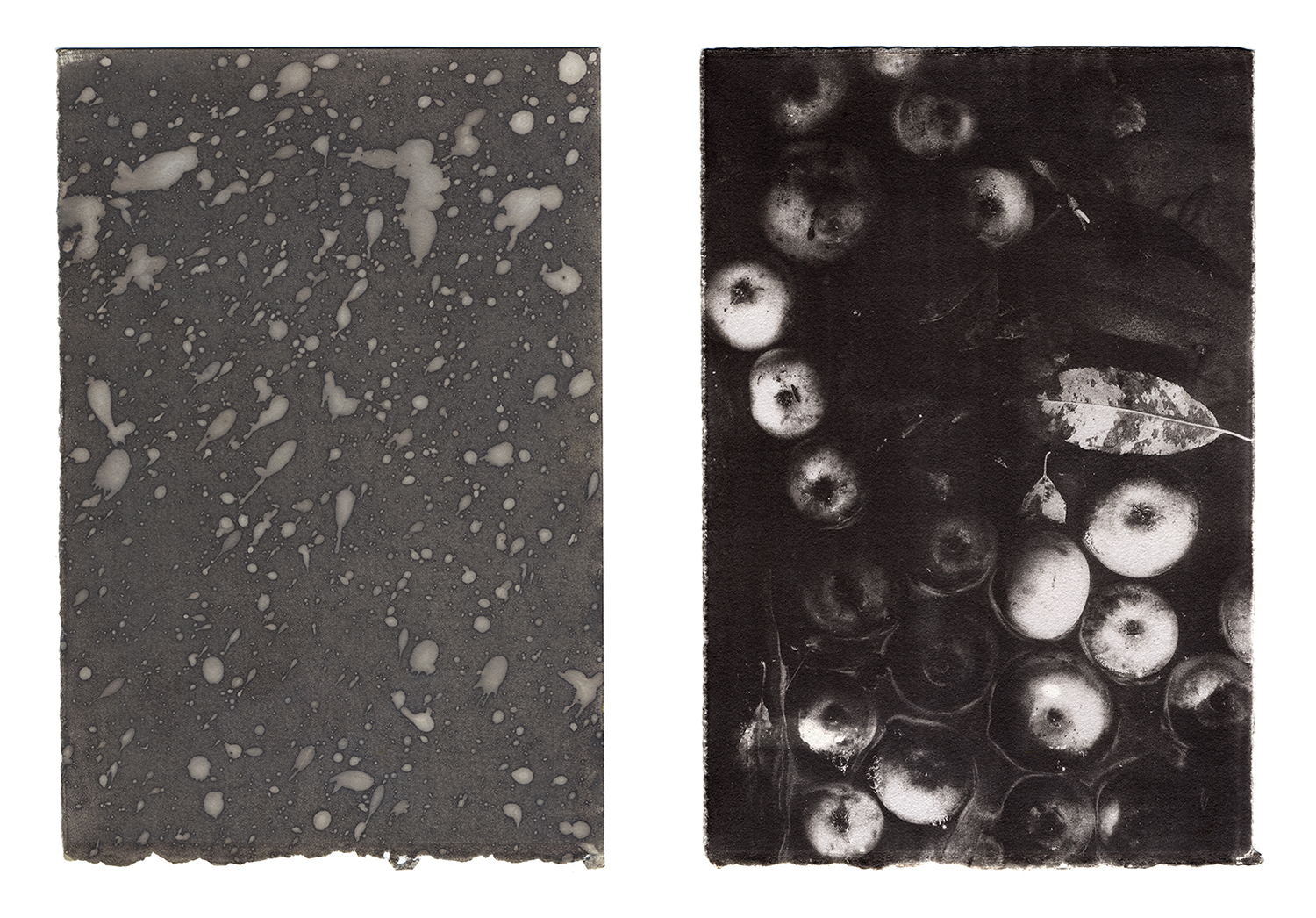
I chose to use the Van Dyke printing process for these works because it allowed me to work directly with the chemical nature of photography. It took months of experiments with chemistry, paper, exposure and negative density to reach the result I was after. I wanted the prints to absorb heavy metals from the water and to have a physical presence that is often lost in the presentation of photographs. A small run of the river with the ideal pH level served as my outdoor darkroom. I exposed the paper using the sun and developed the images directly in the river. The prints were fixed in a solution of sodium thiosulfate, returned to the river for rinsing and then dried on the shore. I'm curious how they will behave over time, but I've embraced the possibility of them shifting in color or density as they age. They are, after all, organic objects: paper, chemistry, water and light.

This project was supported by the Tamarack Artisan Foundation. It will be shown again in Thomas, WV in the Spring of 2016. You can see more of his work here and follow him on Instagram at @jrbrubaker.
All images © John Ryan Brubaker and are used with permission.
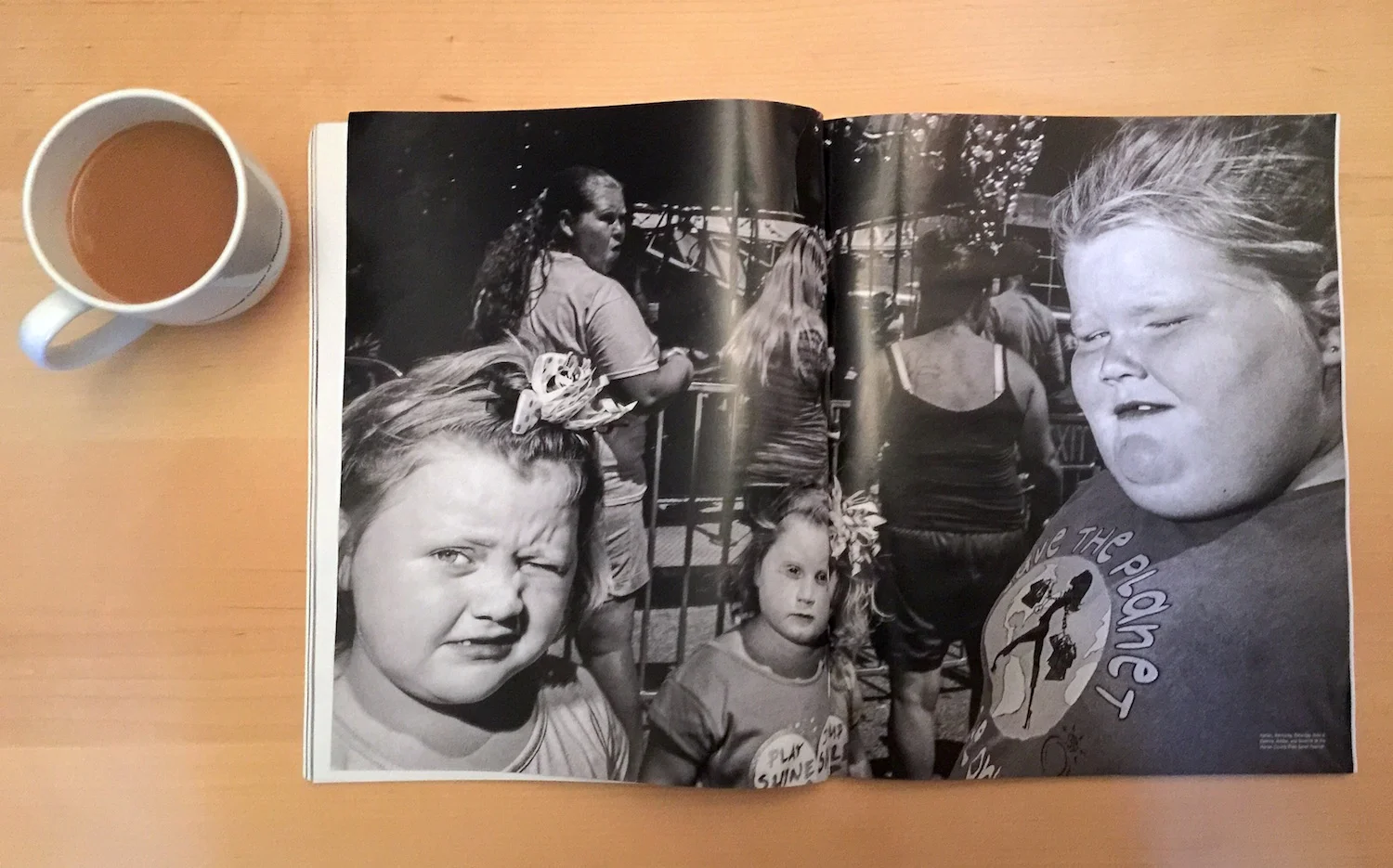
TAKING LIBERTIES, TAKING SHORTCUTS, AND TAKING ADVANTAGE OF PEOPLE

VICE sent two photographers to Appalachia and all we got are these cheap, damaging stereotypes?
In a recent interview, photographer Bruce Gilden said, “…you have to be sneaky to get the picture…” He said other things about respecting his subjects, his need to get very close and that only by veering into abstraction could he get closer. Let us not mistake being close for being sympathetic, though. Outside land-speculators came to Appalachia decades ago. They got so close as to tear into the land. Then they took it elsewhere … and sold it. Outside land-speculators had to be sneaky to get Appalachian coalfield landowners to sign away their mineral rights.
Taking a portrait, of course, is not an abuse on the same scale as taking land.But it is still taking. And just because Bruce Gilden’s in-your-face ambush approach works on bustling city streets doesn’t mean it flies elsewhere. Gilden speaks persuasively about his interactions with folk and stands behind — professionally and literally — his hard-flash and the caricature portraits that result. In some ways, I admire Gilden’s repeated defense of his controversial approach and his repeated willingness to field questions, but still I am not convinced and I don’t think I ever will be. Here’s why. People in different regions and of different histories have very different relationships to the camera and respond accordingly. Gilden’s one-size-fits-all approach doesn’t fit in Appalachia.
Gilden’s latest jaunt in the current issue of Vice (Vol. 22, No.7) is one of more than a dozen portfolios that make up the 2015 Vice Photo Issue. So, it’s worth noticing that Gilden’s portraits are not illustrations for a regular article; they were commissioned for an issue devoted to photography.
Shot over the weekend over June 6th/7th, the series titled “Two Days in Appalachia” includes congregants at the Kingdom Come’s Old Regular Baptist Church in Premium, KY, men at a prayer breakfast gathered at Covenant Mountain Mission Bible Camp in Jonesville, VA, and children and adults at the Harlan County Poke Sallet Festival. In the same issue is “There Ain’t No Grave Gonna Hold My Body Down”, a series of images of church-goers in various Appalachian towns made by photographer Stacy Kranitz.
My assessment of Gilden, Kranitz, their guiding philosophies and work differs somewhat. My criticism of one doesn’t always apply to the other, but for the purposes of critiquing Vice’s decision to assign the two photographers jointly to the region and to run their work back to back, you may assume that my laments in this case apply generally to publication, editors and, yes, both photographers.

Screengrab from the online presentation of the 2015 Vice Photo Issue.
The 2015 Vice Photo Issue is,according to Vice photo editor Matthew Leifheit, “a testament to the enduring power of photography to understand the stories of our lives.” If only. Leifheit goes on to explain that his department teamed up with Magnum Photos by “sending out young photographers out on assignment together with Magnum members, other times emerging artists were influenced by the history of great photographers who have contributed to Magnum’s legacy. Although the approaches to documentation are diverse, we believe both established and emerging photographers benefit from sharing pages.” They also partnered with Magnum’s non-profit arm, Magnum Foundation, to share the work of their regional grantees.
Sending Kranitz and Gilden out together failed.
“The past few days have been hard,” wrote Kranitz on Instagram on June 7th. “I have been on assignment with another photographer, Bruce Gilden. He and I are at odds with the way we make our work. I watched him make portraits and aggressively enter my shot to get his own, while telling me ‘this is my shoot, you are just here’ I listened as he said disparaging things about people, I listened to his dissatisfaction with people being to [sic] ‘plain’ and late last night I could no longer stand by and continue to feel good about being bullied. He humiliated me in front of a group of church goers and I feel that I may have taken a stand at the wrong moment. That I was not being considerate or mindful of my surroundings either. I don’t hate Bruce or his work but I think turning people into what you want them to be, turning people into ‘self-portraits’ of yourself is complicated and dangerous especially in a place with a history of extraction.”
This principled and somewhat vulnerable reflection confirms everything I have thought about Gilden and his personality. It reflects some things I’ve come to learn about Kranitz. Kranitz deals, here and elsewhere, in introspection and flexibility of thought that Gilden never does.
My relationship with Kranitz is strained to say the least and the antipathy between us has been aired in public on occasion. Our commitment to dialogue about photography in Appalachia and our conviction of thought is matched. We’re both steadfast and that contributes to the friction between us.
I want to flag this history between Kranitz and I in order that I may follow-up and say that this article is not a witch-hunt directed at her. This article is a harsh criticism of an abusive project that was rushed, ill-advised and — given the ingredients — doomed to failure. As the liaison (producer?) for the project, Kranitz bears some of the responsibility. Mostly, though, I fault Vice.
A Recipe for Disaster and for Internet Buzz
Leifheit, Vice photo editor, never responded to my request for comment. Not knowing the specifics of the decision-making behind the Appalachia portfolios, I’m left to hazard a guess. GILDEN + KRANTIZ + APPALACHIA = CLICKBAIT, maybe?
By pairing Gilden (aggressive, abrasive, and loud-mouthed shooting style) with Kranitz (drug and alcohol-fueled Appalachia-is-one-big-off-camera-flash-shirtless-party style), Vice knew it was ordering fireworks, or cheap controversy, or both. Neither portfolio shows me anything new.Both reinforce the idea that Appalachia is somehow an exotic location for photographers to drop in and use people as props. They aren’t connected to any other purpose than being self-serving. In other words, they draw attention to the photographer more than the people and communities being photographed.
Gilden, here, substitutes Appalachians in to replace the nameless folks in his last set of portraits. Kranitz’s portfolio was made up, partly, of old images from existing series we’ve seen before. Gilden’s an old dog and you can’t teach an old dog new tricks. Kranitz on the other hand iswrestling non-stop with her image-making, her presence, and the history of representation in Appalachia. Without wanting to sound patronizing, I think Kranitz is self-taught in new tricks — the more she learns the more she realizes she doesn’t know. She’s light years ahead of others, but as well as running rings around the pack she also makes wrong turns. Her Vice offering here is confused.
“I struggled with the complexity of translating the value and power of religion to urban populations, which have long participated in the characterization of rural people as simplistic and naive,” wrote Kranitz in her accompanying statement. Why does this need translation? And how does her series of images do anything to work against the characterization of rural people? We’ve all seen the visual tropes that cue the most widely known visual “facts” about Appalachia. What is it about this work that stretches us to see it differently? I appreciate Kranitz’s long-form work and commitment in the region, I believe she is on the verge of shifting to pursue something bigger than herself, but she keeps getting in the way.
Kranitz declined to speak with me for this article about this Vice assignment. She believes my decision to not invite her to serve on the board of Looking at Appalachia, an organization I founded, was an attempt to silence her voice. Since then, she has characterized me as running a“tyrannical crusade as gatekeeper of who can and cannot make work in the [Appalachia] region.” I disagree with her assessment of my work with Looking at Appalachia. I disagree that I’ve silenced her voice. I did not ask her to join Looking at Appalachia in an official capacity for reasons that I don’t care to make public.
Putting these things aside I realize this moment is a missed opportunity to speak with a young photographer with whom I (and Looking at Appalachia) share common concerns. I would not expect the same level of engaged conversation with others. Leifheit, I’d suggest, gave more time and consideration to his project PPIX, wherein he photographed things he peed on for 30 days than he did for Gilden’s “Two Days in Appalachia.”
Shut Down by Magnum, Ignored by Gilden
I suspect both Vice and Magnum both spent more time conceiving, planning, executing, and editing the Gilden assignment than he actually spent in Appalachia. Perhaps that’s the case sometimes if you’re a news agency on a tight deadline, reporting on time-sensitive issues. That’s hardly the case with this work. Why send Bruce Gilden to a part of the country that’s been visually stereotyped more often than not, to shoot in a style that, albeit bold, is incredibly impersonal and is stripped from nearly any context? Unfortunately, I cannot fully answer that question because despite a thoughtful and productive 45-minute telephone conversation with Cameron Cuchulainn, Magnum Photos Special Projects Manager, the follow-up email with specific questions I was requested to send, and sent, was met with zero response. Nothing. Zip. Later, I received a courtesy call from a reliable source who informed me the stonewalling was deliberate. I was shut down by Magnum. The fact that no one would respond in any official capacity to this type of work speaks volumes. I am beside myself, though I probably shouldn’t be, that an agency like Magnum would put their integrity, and that of its members, on the line in such a fantastically amateur way.
Am I saying that Gilden can’t or shouldn’t make work there? Absolutely not. But if he’s going to make work there, he can’t be the least bit surprised if there’s a strong negative response to his style of shooting and his presentation of these folks in an international magazine.
How is this work any different from the throngs of photographers who’ve made this sort of devoid-of-context work? Bruce, if you have an answer please get in touch; your studio manager said he passed my email along, but that was weeks ago. As with Magnum, I have no idea what you’re thinking.
It’s a slippery slope when you come to a region often misrepresented or only represented in a certain light, and use people as props. No amount of contrived language, heady MFA-speak, or artistic vision can make up for any of that. I don’t care what agency you work for. In the end, it’s the people who allow us into their lives that matter. People aren’t theories. We have no feedback from the people pictured. Will they receive copies of the magazine so they can see how they’re composed, framed, and displayed? Was it made clear who the photographers were on assignment for?
Vice catastrophically catapulted two headstrong photographers into Appalachia. Two different photographers, people, and approaches with unsurprisingly the same outcome.
There are photographers who want to be looked at and celebrated and there are photographers who want to see people and celebrate them through photography, in context, in a way that honors the people. Sadly, Gilden and Kranitz miss out on the latter — far more so Gilden than Kranitz. To Krantiz’s credit, she is devoted to making work in the region and spending lengthy blocks of time in Appalachia. I believe, like many of us, her work is evolving, but when I see it side-by-side Gilden’s in Vice presentation, I struggle to see a difference.
Appalachia is big enough for all of us to be making work that matters, work that can effect change — not only in us, but inside and outside the region. But this isn’t it. As they should, these images will be lost in the noise created by a media outlet more concerned with clicks and buzz than the people photographed in their stories.
More takers in a long line of takers.
(This article first appeared on Vantage on 31 July 2015.)
©Roger May, 2015. All rights reserved.
William Gedney's Eastern Kentucky Photographs

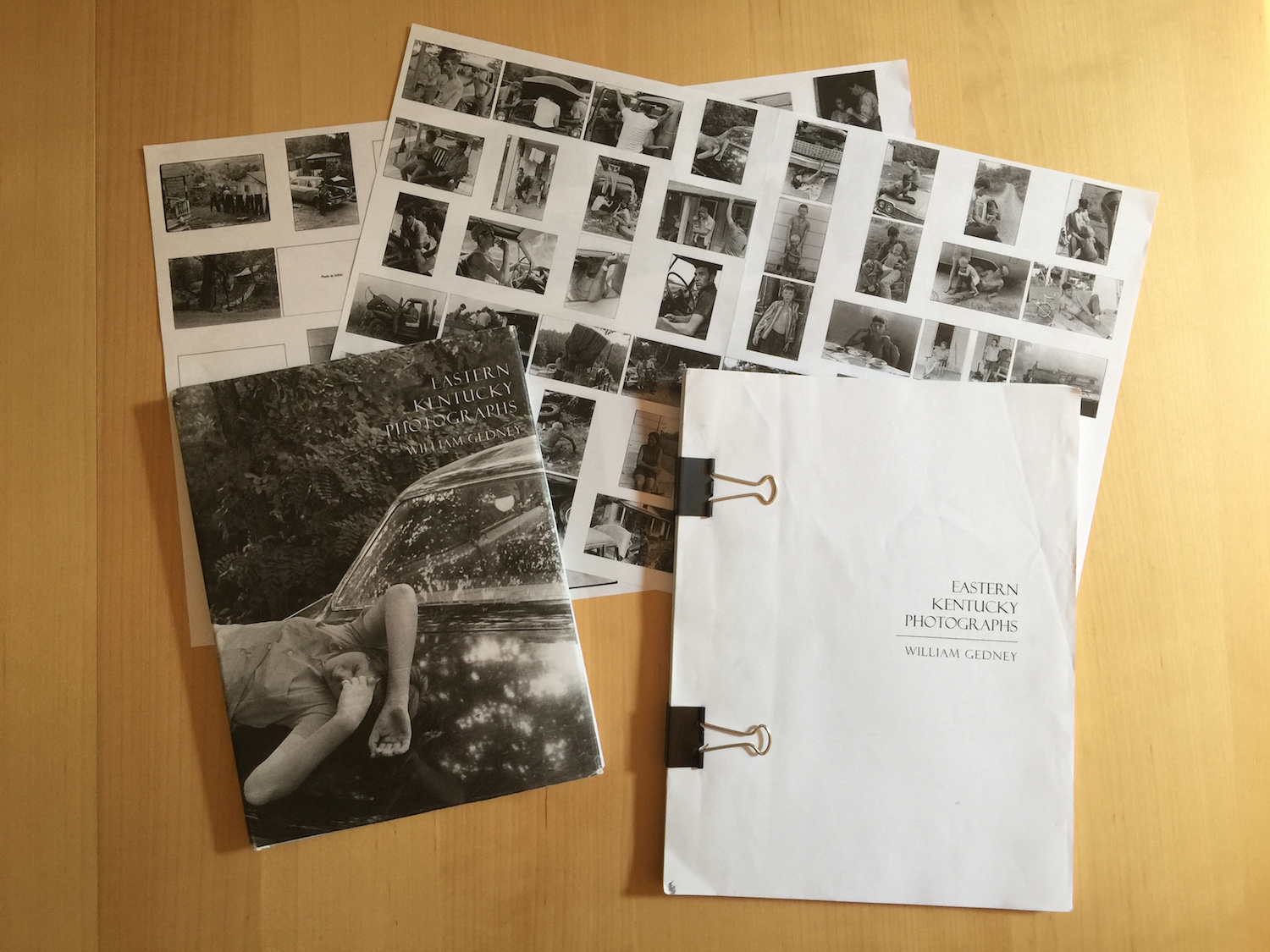
One of the things I’m most fond of is seeing how other photographers and artists work. If I see a picture of an artist in their studio or workspace, my attention is usually drawn to the background where I find myself looking at bookcases, work tables, and other “stuff” in their creative space. I also truly enjoy behind-the-scenes snippets of how they work and how things come together. In that vein, I wanted to share a bit about a book project I’ve been working on for some time now. It’s far from complete and very much an early draft. I have no publisher and real idea of the market interest in a book like this. There is still a good deal of text to write for the book. Nonetheless, I think it would make a wonderful book, so I plan to move forward.
I had never seen a William Gedney photograph before beginning classwork at Duke’s Center for Documentary Studies. Gedney’s work is archived at Duke’s Rubenstein Rare Book and Manuscript Library. One of our classes visited the archive and I was immediately taken with his photographs. What’s most striking to me about Gedney is that he went to eastern Kentucky at a time when most of the pictures being made there were being used to highlight and call attention to poverty. What’s more is that he only made two trips there in 1964 and 1972, spending a total of 29 days in Kentucky. Yet many believe, as do I, that this is some of the strongest work of his career. He quickly became a part of the Cornett family and worked amongst them with a meticulous, quiet familiarity shown in the photographs he made there.
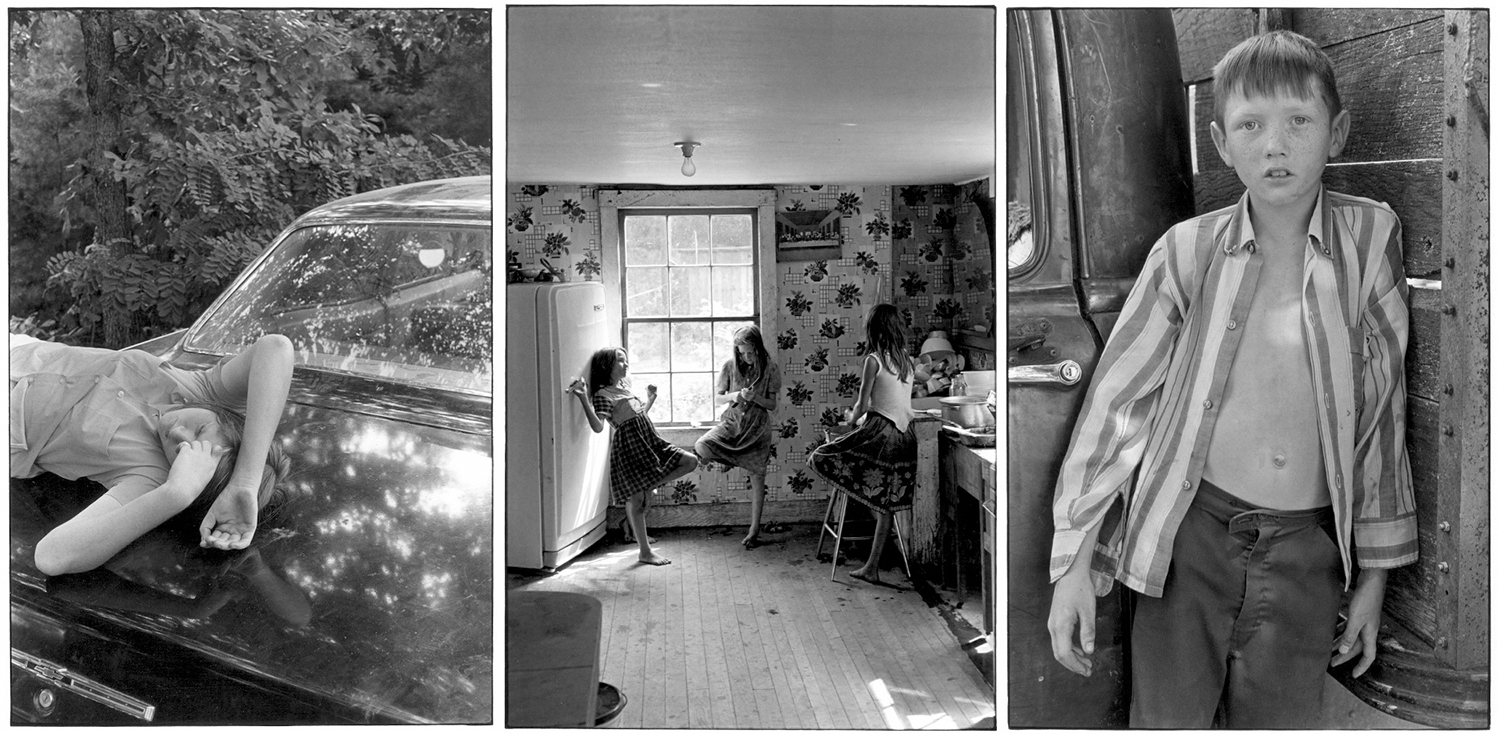
In the early 1960’s, Appalachia saw a flood of photographers, news crews, and filmmakers (think Charles Kuralt’s Christmas in Appalachia circa 1964) come into the hills and hollers as part of the War on Poverty campaign. By and large, they formed a disparaging visual narrative of the place I was born and raised. Yet somehow, William Gedney transcended that tendency and instead made photographs of grace, beauty, and simple existence all the while capturing the real environs of his subjects. There must’ve been something about his spirit that caused him to see what others did not, would not, perhaps could not.
William Gedney died on June 23, 1989 at 56. In his lifetime, he was awarded a John Simon Guggenheim Memorial Foundation Fellowship for photography (1966-67), a Fulbright Fellowship for photography in India (1969-71), a National Endowment for the Arts grant in photography (1975-76), and several other grants and fellowships. He had a show at the New York Museum of Modern Art (1968-69) as well as more than a dozen other exhibitions. What surprised me about this is that Gedney never published a book. Four years after his death, in 1993, Duke University became the repository for 51.3 linear feet of Gedney’s work. Margaret Sartor, a photographer, writer, and teacher at the Center for Documentary Studies at Duke, was approached by the library and asked to put together an exhibit of Gedney’s work. In 2000, Sartor and Geoff Dyer coedited What Was True: The Photographs and Notebooks of William Gedney, which quickly sold out and is now out of print.
As years passed and my fascination with Gedney and his Kentucky photographs grew, I began spending time in the archive going through boxes and boxes of work prints, notebooks, and book dummies. It was here that I came across hand-sketched thumbnails (below) of an early draft for a book of his eastern Kentucky photographs. There were several pages of sketches, several of which listed the corresponding negative and contact sheet number, and it became clear that this was a book he wanted to make. He split the book into two parts – 1964 and 1972 – and included 80 photographs. Thanks to his notes, I was able to identify and locate 73 of the 80 pictures in the archive at Duke. The entire Gedney collection is currently being re-digitized and I hope to be able to identify the remaining seven pictures later this year. Including some of these sketches in the book will be a fascinating addition.
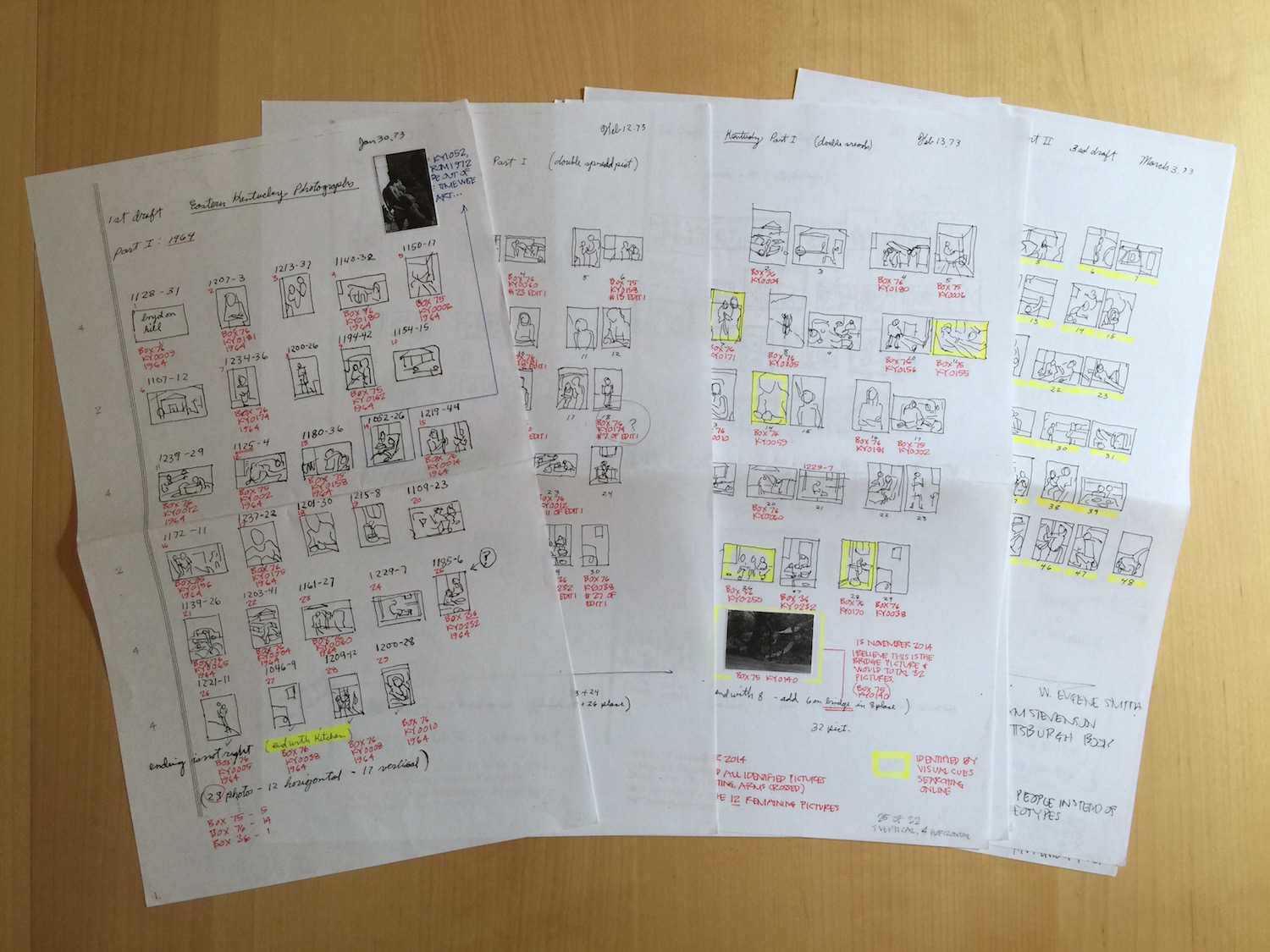

While working on this, I ordered and sequenced the images according to Gedney’s sketches and notes and created a couple of 11" x 17" contact sheets to study and understand his process a bit better. I also created a mock cover and used it to wrap my copy of Andre Kertesz: Paris, Autumn 1963, which incidentally is very similar in makeup with how I’d like to design the Kentucky book. It measures roughly 7.5" x 9.5", 80 pages, and was published by Flammarion in 2013.
I've consulted with Margaret Sartor, who was kind enough to invite me over to dinner earlier this year and along with her husband, Alex Harris, helped me think through some of the processes needed to make this book come to life. She has been instrumental in my learning about Gedney’s work. Lisa McCarty, curator of the Archives of Documentary Arts at Duke, has been incredibly supportive of this project and seeing it come to fruition.
So, if you’re a publisher, love the work of William Gedney, and want to see this book made, please drop me a line. I’d love to talk with you.
All three vertical photographs – William Gedney Collection, Duke University David M. Rubenstein Rare Book & Manuscript Library. All other photographs and content - ©2015 Roger May
Why a Confrontation Between Photographers and Locals Turned Ugly in Appalachia

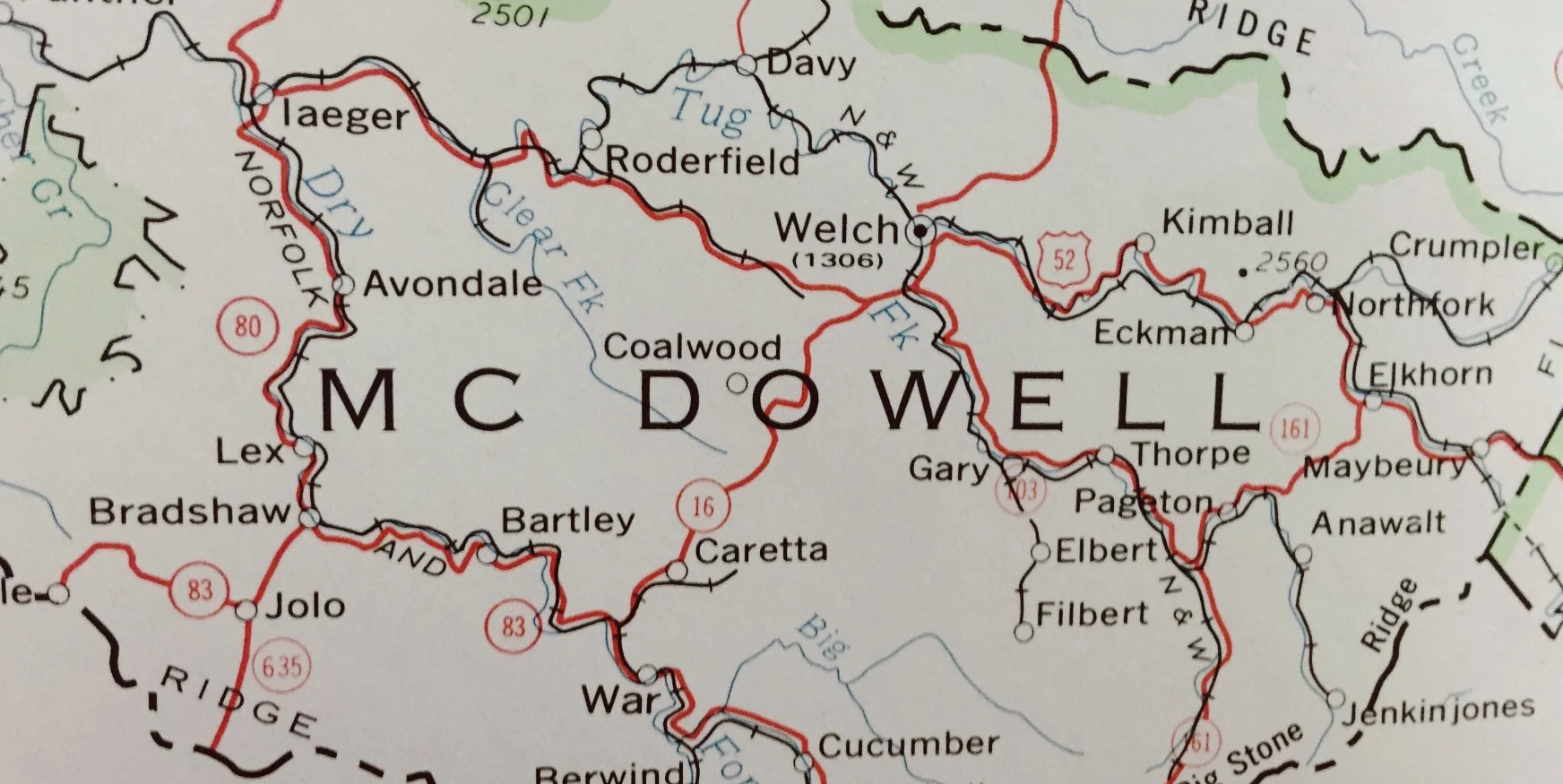
On Monday, March 23, in McDowell County, West Virginia, photographer Marisha Camp and her brother Jesse found themselves confronted by an angry and hostile group of folks, who accused them of taking photographs of children without permission. The Camps, who were on the road gathering material for a television show they hope to pitch later this year, were detained and threatened with physical violence by these local citizens. After a 45-minute confrontation, the Camps were escorted out of the county by the West Virginia state police.
The story was picked up by local news stations and by national photography magazines and blogs. As is usual when Appalachia is the subject, the story was told primarily by and about one group—outsiders visiting the area. That’s not to say the Camps’s accounts of what happened aren’t valid, but they’ve been given a platform not afforded many of the others involved. The locals have been portrayed as vigilantes, as mob- or gang-like. One national photography magazine titled their story, “West Virginia Mob Reportedly Detains Photographers for Looking Out-of-Town.” Let’s be clear: the Camps weren’t detained for looking “out-of-town.” They were detained, illegally this West Virginian and photographer believes, because parents thought they'd photographed their children without their permission.
Knowing that I am from West Virginia and that I have a professional and personal interest in work being made in and about Appalachia, a friend posted the news story on my Facebook wall. Several other people contacted me to ask what I thought about the situation. After watching the local news story, I knew there was much more to the story. I knew there would be fallout, and feared that locals would bear the brunt of it.
Searching for a greater understanding of the incident and the actions that caused it, I began reaching out to those directly involved. I contacted Marisha Camp on Thursday, March 26, and over the next few days I exchanged calls and dozens of text messages with her and her brother. On April 2, I spoke with Jennifer Adkins, the woman who accused the Camps of photographing her children and threatened them with a gun.
I also contacted journalists and filmmakers who have worked in Appalachia, and a local photographer, to gain as much perspective as possible about what happened that day. I asked them to comment on the situation in McDowell County because none of the reporting thus far attempts to look at the long history of misrepresentation in Appalachia. Sure, this could’ve happened anywhere. But it didn’t. It happened in McDowell County, West Virginia. And although the Camps may not have been intentionally seeking out “poverty porn,” many local residents view photographers, both insiders and outsiders, with understandable suspicion.
“You don’t look like upstanding citizens.”
The Camps had been on the road for months, working their way across the country filming and making photographs. On Sunday, March 22, they filmed a church service in McDowell County. The following day, they decided to collect B-roll footage. “We noticed these three obese kids playing with sticks in [a] driveway,” Jesse Camp recalls. “When we drove by I asked them if they were having a stick fight. They sort of laughed and that was that. We drove on.” On their way from Jolo to Raysal, the Camps parked their Volvo station wagon with Massachusetts license plates at a gas station and crossed the road to photograph some houses and talk with some folks. Soon thereafter, Marisha Camp heard someone yelling across the road and noticed a van blocking in their vehicle. The van’s owner, Jennifer Adkins, was upset because she thought the Camps were photographing her children without her consent, and she demanded the pair hand their cameras over. The situation escalated quickly.
According to Marisha Camp, Adkins immediately threatened them. She opened the door of her van and pointed to what she said was a gun, stating that the Camps weren’t leaving until they handed over their cameras and the police arrived. Afraid and panicking, Camp tried to call for help, but had no cell service. Camp was able to record audio of the incident on her phone. “Have you all looked at yourselves in the mirror? You don’t look like upstanding citizens,” Adkins can be heard saying on the recording. For nearly 45 minutes, the situation intensified. An angry crowd grew around the Camps, despite Marisha Camp showing Adkins’s husband the images on one of their cameras in an attempt to prove that none of the images were of their children.
Local parents were already on edge due to the disappearance of a young child in the area: The same day the Camps were filming the church service in Jolo, less than a hundred miles away in Pulaski County, Virginia, five year-old Noah Thomas went missing. The sheriff’s department received more than a hundred tips, many of which identified suspicious vehicles in the area. (Sadly, Thomas’s body was found on his parents’ property in a septic tank Thursday, March 26, five days after he was reported missing. His parents have been charged with felony abuse and neglect.)
Finally, West Virginia state police arrived on the scene. After assessing the situation, they escorted the Camps out of the area and lectured them about how they “ought to be careful about not making ugly pictures about the people of West Virginia,” Marisha Camp says. Later that day, she contacted the McDowell County sheriff’s department and was told by a deputy, “You’re lucky you weren’t shot.”
“We love West Virginia.”
“I’m a gypsy, self-admittedly,” Jesse Camp told me on the phone on March 31. “I love traveling every nook and cranny of America. My sister and I have been road tripping forever, man. We’ve been everywhere, all over the South, and 99 percent of the people we meet are cool.”
Jesse Camp says he and his sister had been all over West Virginia. “Logan, Omar, Iaeger, War, Jolo and Bradshaw. You know man, West Virginia is like the most outlaw place. We love West Virginia.”
Marisha Camp echoes her brother, and she’s been actively responding via Facebook to inaccurate claims from McDowell County residents about the incident. “We really love West Virginia, and it was utterly heartbreaking to think about not going back,” she says. “I know not everyone [there] is like that.”
Also upset by the behavior of the police, Marisha Camp wrote a letter to West Virginia Attorney General Patrick Morrisey, detailing the events. In the letter she writes that she “strongly believes” in combatting “negative stereotypes of the region,” but calls the actions of the police “absurd and about as counterproductive as it gets.”
“It is for everyone's benefit that incidents like this are taken seriously,” she writes. “I would have been encouraged to press charges anywhere else rather than be run of town like a ‘long haired hippie’ and then told by law enforcement that I'm somehow lucky because I wasn't murdered.”
Despite all this, the Camps say they’ve received overwhelming support from residents of McDowell County. Many have contacted the Camps via Facebook apologizing for the actions of a few people and offering them places to stay if they make it back.
“We had no choice but to question their motives.”
Jennifer Adkins was on the phone with a neighbor when her 13-year-old son walked in the front door and told her, “there was a guy out there taking pictures.”
Adkins hung up the phone and immediately called 911 to report the incident. She, her husband and their two sons got in their minivan and drove after the Camps in order to get a license plate number. (As a parent, I understand the fear and concern Adkins must have felt for her children in the moment, especially considering the missing child in the news.) Once they found the Camps's vehicle at a gas station in English, they called 911 again to report the tag information.
“I was floored by their appearance. They looked like bums. I don’t mean that to sound derogatory, but they did,” Adkins told me. “I saw [Marisha Camp] put one of her cameras away and then she started showing my husband pictures from the other one.”
Both Jesse and Marisha Camp deny making photographs of the Adkins’s children. But the family didn’t know what the Camps were up to because they never came to their door to ask if it was OK to talk to their children or photograph them. Therein lies the problem for me, and for Adkins. “I can understand them [the Camps] being scared, but we had no choice but to question their motives,” Adkins says. “I wouldn’t have ever given them permission to take pictures of my kids, let alone talk to them, but they never gave me the chance.”
Adkins admits she threatened the Camps. “I mean, I said I had a gun, but I didn’t. I wanted them to know I meant business and that they weren’t leaving until the police showed up. I told [Marisha Camp] that she could leave by ambulance or by a police car, but she wasn’t going nowhere until I saw that she didn’t have pictures of my boys,” Adkins recalls. Soon thereafter, Adkins says, residents she didn’t even know began to gather around. She says the other residents, who must’ve felt they were looking out for their own, "sort of took over."
I asked Adkins about judging the Camps by how they looked when for so long West Virginia has been the butt of so many jokes about appearance. I had a really hard time with this one. “I know,” Adkins says, “but if I go to New York City, I’m going to stand out and possibly be stereotyped. Anybody who knows me knows that I’m outspoken. We [West Virginians] always get portrayed bad. And we didn’t know what they were up to.”
A few days after the confrontation, Adkins was interviewed by WVVA, the local news station, after they saw her Facebook posts about the incident. Adkins has taken down most of the posts, but I had taken screenshots for my notes. In one post, she wrote, “They are from Mass. and said they were doing a ‘documentary’…. All I can say is they best NOT COME BACK TO RAYSAL!!!!!” Someone commenting on Adkins’s Facebook page posted the Camps’s license plate number, and several commenters also included pictures of the Camps’s vehicle.
“We don’t get to choose who makes work in Appalachia.”
Elaine McMillion Sheldon, a native West Virginian, spent more than three years on and off working on Hollow, an interactive, community-driven documentary project about McDowell County’s past, present and future from the perspectives of local residents. When I reached out to her, she was beside herself about the incident and didn't understand why residents would react as they did. “What is the goal here? I think it's a question of how we want to be seen,” she says. “Do we want to be seen as a threat?”
Sheldon says residents she talked to in the County are divided about the incident. She was surprised that local photographers told her they don’t agree with the kind of work the Camps were making. Sheldon says: "We don’t get to choose who makes work in Appalachia. We can’t police who makes pictures here, but we should try to educate those who want to come in to document, and encourage a more nuanced story. We all need to stand together as artists, regardless of whether we like a specific artist’s work or not. You can't pick and choose whose rights you support based upon whether you like or dislike their work. All artists have the same legal rights, regardless of the art they create."
“The visual equivalent of hate speech.”
Kate Fowler has worked in West Virginia extensively and was recently hired by the Magnum Foundation in New York. Her film, Nitro, chronicles the complicated relationship between a small West Virginia town and the chemical plants that both provide jobs and impact the environment in West Virginia’s “Chemical Valley.” Fowler also spent a great deal of time in McDowell County working on her film With Signs Following, about the late Mack Wolford, a preacher and serpent-handler from southern West Virginia.
Fowler views the actions of the Camps and the reactions of the local citizens as part of a long, complicated history of photography in Appalachia.
Many in West Virginia, Fowler says, recognize that outsiders who’ve photographed their communities without consent have participated in the “dissemination of classist and bigoted rhetoric—the visual equivalent of hate speech.” Fowler also points out that when a small group of citizens decided to speak up for themselves, “the Internet...mobilized to discredit and to once again, deny the subject’s capacity for critical engagement.”
“No person deserves to be threatened with violence” or held against their will, Fowler adds. But, she says, “We [as photographers] must not presume that our intentions are clear, nor deny the trauma we may invoke through our actions, tools or intentions.”
“Am I supposed to go and knock on each and every door?”
Alan Johnston is a native and lifelong resident of McDowell County, West Virginia. He’s a musician and landscape photographer I met several years ago through Sheldon’s Hollow project. I reached out to him to get a local photographer’s perspective on what happened and he was kind enough to talk with me.
Johnston says he was “genuinely concerned” when he heard about the incident, especially when he considers what it might mean for his ability to work locally. “I really don’t understand what I’m supposed to do,” he says. “Do I tell somebody at the mouth of the holler that I’m taking pictures of barns and landscapes? How will the people in the head of the holler know what I’m doing? Am I supposed to go and knock on each and every door and report to people who I am and what I’m doing?” He notes that he rarely photographs people he doesn’t know, but rather photographs landscapes of McDowell County for his own pleasure.
Johnston recalled a time a few years back when he was out making pictures in the county and pulled off on the side of the road to photograph a horse in a barn. “All of a sudden this woman came out on her porch and started yelling at me. ‘You better not take any bad pictures on this mountain,’ she yelled.”
He staunchly defends his right to make pictures on public property, but confided that there are a whole lot of people “skeptical of anyone doing anything around here.” So it’s clearly not just outsiders that are met with suspicion.
Cultural insensitivity and privilege
Jesse Camp says this could’ve happened anywhere. It’s true. It could’ve. But it didn’t. It happened in West Virginia. And if you’re not familiar with the long history of visual misrepresentation of the region, then close your eyes and think about the first thing that pops in your head when you hear the words “West Virginia.” See what I mean?
Understanding the very real history of misrepresentation in Appalachia—particularly McDowell County, West Virginia, which is often portrayed as a hopeless pocket of rural Appalachia (a depiction I take great issue with)—by no means implies that it’s justifiable to hold people against their will and threaten physical violence. It’s also unreasonable to judge anyone by his or her appearance or how they talk, no matter who they are or where they’re from. But it’s important, although not easy for everyone, to understand where the anger comes from. It’s only through self-awareness that both photographers and local residents can hope to prevent incidents like this.
West Virginia is in my DNA. It’s a huge part of who I am. I’m also a photographer, which is an equally huge part of who I am. Often when these two meet it can be a challenge to find a balance, to reconcile history with the present, to challenge what we’ve been shown with what we know. I’m all too aware of how we’re portrayed, joked about and stereotyped. I’m also aware of how important listening is, and how making work in Appalachia isn’t as much about me as it is about honoring, respecting and searching for home. I’m not saying the way I work is the right way, if there is such a thing, but I am saying I don’t want to be another taker in a long line of takers.
Without a true understanding of the long history of takers in Appalachia, it can be hard to understand why locals reacted the way they did. The Camps deny both their privilege and a lack of understanding. They stated to me several times that they’ve been living out of their car, wearing the same clothes over and over again, and doing so with little to no money. But there’s nothing that pisses underprivileged people off more than privileged folks blind to their own privilege. Does that make the Camps bad people? I don’t think so. Does being threatened, blocked in, called names, yelled at and held hostage until state police arrived seem warranted? Again, I don’t think so. The Camps are likable people and I’ve found nothing in the time I’ve spent communicating with them that would lead me to feel otherwise, but I can raise concern over their cultural insensitivity.
Does that mean they can’t make work in Appalachia? Absolutely not.
Privilege can be tricky. I know this all too well. But photographers should be aware of it and sensitive to it. Marisha Camp was quick to counter my mention of this via text. “I’ll bet that lady [Jennifer Adkins] makes more money than me.”
This isn’t a situation in which it’s easy to either support the photographers or support the community. It’s much more complex than that. What would’ve happened if the Camps had knocked on the door of the Adkins house? What would’ve happened if Jennifer Adkins had simply left after seeing no pictures of her children had been taken? If the Camps were more apologetic and disarming in their responses, would the situation have escalated?
This isn’t just a place in a road trip documentary. This place is my home. It’s true that we can’t police who does and doesn’t make work in Appalachia. But when I reflect on this situation, I’m reminded of a saying by my granddad, “Enough is enough and too much is nasty.”
Thanks to Marisha Camp, Jesse Camp, Jennifer Adkins, Elaine McMillion Sheldon, Kate Fowler, Joy Salyers and Alan Johnston for their time in contributing to this article.
(This article first appeared in PDN on 21 April 2015. A condensed version appeared in the July 2015 print issue of PDN.)
©Roger May, 2015. All rights reserved.