Testify Update | Project Statement & Housekeeping
So, my portfolio site is experiencing technical difficulties. While I'm in the process of rebuilding it, I wanted to share my Testify project statement as well as another look at the book dummy I'm working on. Thanks for your patience and I'll let you know when my portfolio site is up and running again.

Testify is a visual love letter to Appalachia, the land of my blood. This is my testimony of how I came to see the importance of home and my connection to place. After moving away as a teenager, I’ve struggled to return, to latch on to something from my memory. These images are a vignette into my working through the problem of the construction of memory versus reality. My work embraces the raw beauty of the mountains while keeping at arms length the stereotypical images that have tried to define Appalachia for decades.
The word ‘testify’ carries both a religious and legal meaning. In the pentecostal holiness churches of home, a portion of time during a church service is devoted to allowing members to share publicly what God has done in their lives; their testimony. In legal terms, one’s testimony is a statement accepted, sworn under oath, believed to be true and acceptable.
I am both an insider and an outsider and though I maintain a safe distance in my photographs, I attempt to invite you into the intimacy of family, of sacred space. Testify is my bearing witness of a personal journey, of never truly being able to go home again, to seek answers from my ancestral home. Appalachia testifies of timelessness and natural beauty. The mountains testify of protection and sanctuary and at the same time the horrible destruction of mountaintop removal mining. The people of Appalachia testify of their pride and resilience. Old time religion testifies of the power in the blood and a heavenly home just across the shore.
My grandfather told me that I have two ears and one mouth, which means that I should listen twice as often as I speak. Through these images, I’ve tried to do just that - to listen more than I speak, both with my voice and my cameras. These images arise out of my pride of where I am from and where I am of, and an enduring love for Appalachia.
This is my testimony.
Testify
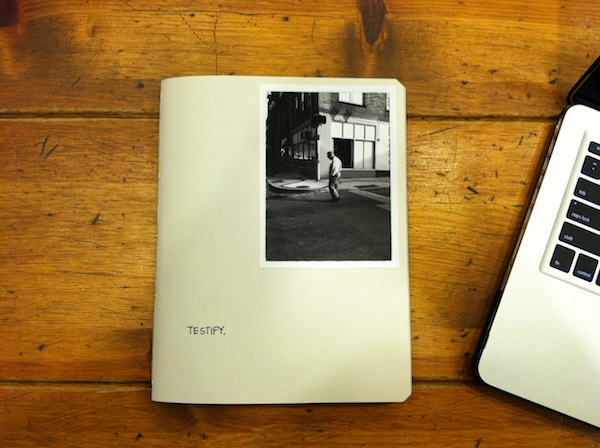
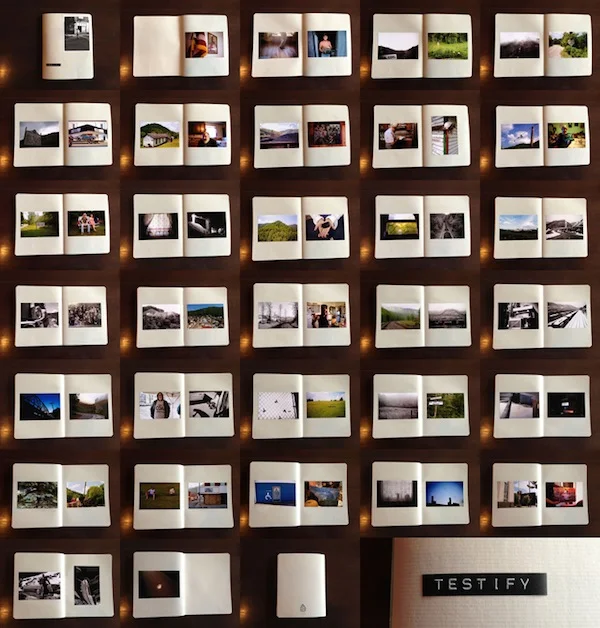
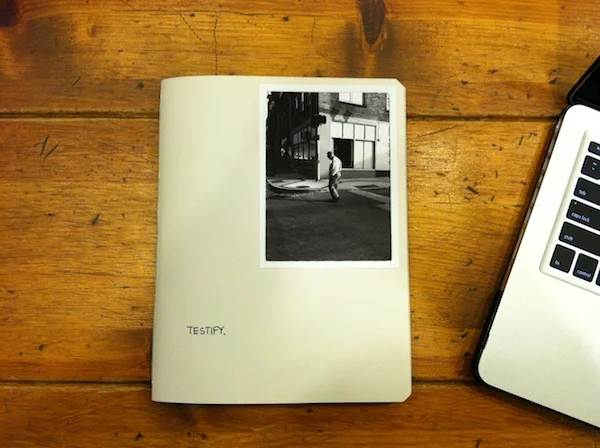
I've started working on a book for my Testify photographs. I'll confess I don't have a clue as to what I'm doing, but I'm having fun. That counts for something, right?
Several months ago, I bought a BLACK PINE saddle-stitched journal (it measures 7.5" x 9.5"). I didn't really have a plan for it at the time, so I put it on my bookshelf and forgot about it. Over the last few weeks, I created a new edit of the Testify work and posted 60 images on my portfolio site. I didn't spend a great deal of time sequencing the images online, but I wanted to get them out there, to get some feedback, to see how they worked together, if at all.
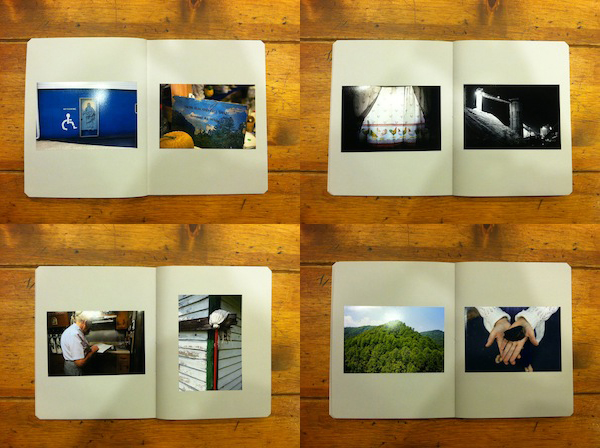
I decided to make some cheap 4" x 6" prints (laid out on my dining room table below) to see the work as a whole and some place other than a screen. I remembered I had the BLACK PINE journal and, after checking, there were exactly 30 blank pages and 60 prints. After a couple of evenings and a roll of two-sided tape, I put together the first book of the work.
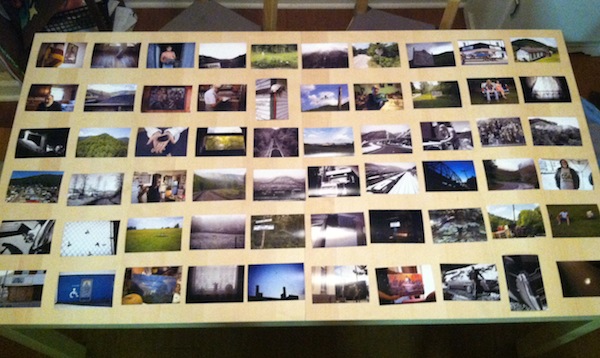
Over the next few months, I'll be working on a PDF layout of the work as well writing the text for the book. If there's any interest, perhaps I'll put out a zine. I really like what Michael Friberg's done here. (I can't wait to get mine in the mail.)
Thanks for looking.
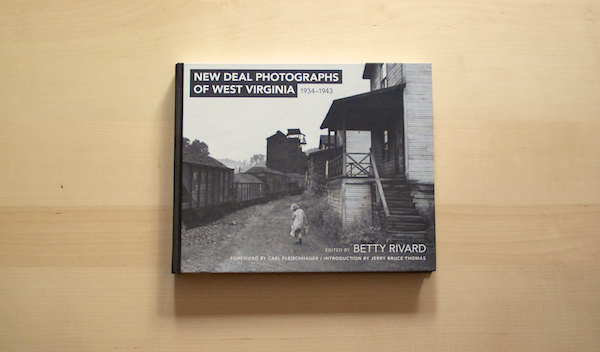
Review: New Deal Photographs of West Virginia, 1934-1943
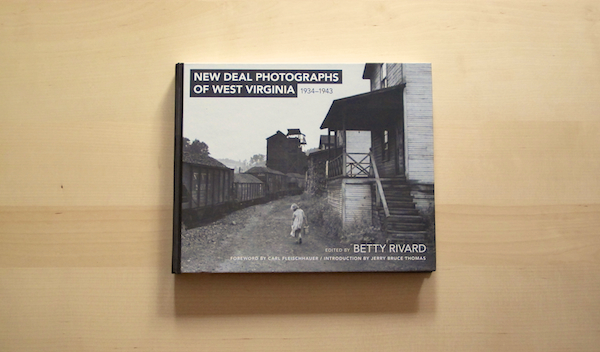 Hardcover| 8 x 9.5 inches | 240 pages | 150 black and white photographs
West Virginia University Press, 2012 | $29.99
Hardcover| 8 x 9.5 inches | 240 pages | 150 black and white photographs
West Virginia University Press, 2012 | $29.99
Between 1934 and 1943, ten photographers: Elmer "Ted" Johnson, Walker Evans, Ben Shahn, Arthur Rothstein, Carl Mydans, Edwin Locke, Marion Post Wolcott, John Vachon, John Collier, Jr., and Arthur Siegel, visited West Virginia as part of Roy Stryker's Farm Security Administration (FSA) photographic unit. The FSA's primary attention during this time was on the northern and southern coalfields, the three subsistence homestead communities (Arthurdale, Eleanor, and Tygart Valley), and two wartime assignments in Nicholas and Mason counties.
What Rivard offers in this beautifully presented book, is a collection of images by photographers whose work I know well of West Virginia at a time I never knew. I'm fascinated with how others see my home state. None of these photographers are from West Virginia, yet they managed to capture its essence, its livelihood. Perhaps one of the things I appreciate most about these pictures is that they were made at a time when photographs weren't nearly as a prevalent as they are today (Instagram, Facebook and the like). Unlike the War on Poverty images of Appalachia, these pictures were made with a different intent. I sense a true collective effort to document the people and stories of West Virginia when I look at these photographs and think about the photographers who made them. Rivard notes that, "The photographs in this book offer professional fine art photographs in support of these memories, snapshots, and stories."
She continues:
"It is beyond the scope of this book to explore why, especially in the past fifty years, the state became a poster child for a culture of poverty. Unfortunately, the media have focused on poverty and exaggerated backwoods-type images as representative of West Virginia. These images have left terrible scars on a number of people who have grown up in the state. They also continue to bring harm through the perceptions that some outsiders have formed of the state and its citizens."
Rivard does a more than fair job of including images from a variety of the photographers as well as the regions covered. As a Mingo County native, I was somewhat disappointed to not see any photographs of Williamson or outlying areas included in the Southern Coalfields section, given Mingo's rich coal heritage and importance in the labor movement. But I admit my bias and am including an image (not in the book) by Ben Shahn made in Williamson in 1935. Logan and McDowell counties are well represented in pictures by Ben Shahn and Marion Post Wolcott.

New Deal Photographs of West Virginia is a brilliant book, extremely well edited and designed. The photographic reproductions are sharp and well printed and with every image, the Library of Congress negative file number is included, which makes finding them online incredibly easy. I can only hope for a second volume.
Betty Rivard is an award-winning fine art landscape photographer. She has researched and coordinated three exhibits of FSA photographs of West Virginia and contributed to articles about the FSA Project to Wonderful West Virginia, Goldenseal, and West Virginia South magazines. She is a Social Worker Emeritus and traveled to every county in West Virginia during her 25-year career as a social worker and planner with the state. Rivard's photography portfolio can be seen here.
Here are a few of my favorites from New Deal Photographs of West Virginia:

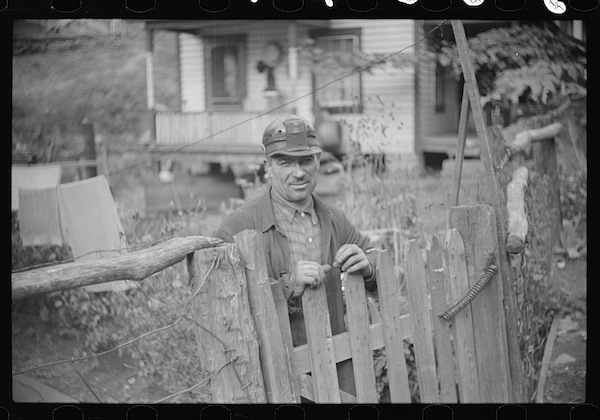


1. Wives of coal miners talking over the fence. Capels, West Virginia. Marion Post Wolcott. September 1938. LC-USF34-050260-E. 2. Miner (Russian). Capels, West Virginia. Marion Post Wolcott. September 1938. LC-USF33-030077-M1. 3. Men in Sunday clothes with miners' clubhouse in the background. Omar, West Virginia. Ben Shahn. October 1935. LC-USF33-006200-M1. 4. Coming home from school. Mining town. Osage, Scotts Run, West Virginia. Marion Post Wolcott. September 1938. LC-USF34-050352-E.
Very special thanks to Elaine McMillion, director of Hollow: An Interactive Documentary, for arranging a review copy of New Deal Photographs of West Virginia.
Rob Amberg Photobook and Print Giveaway

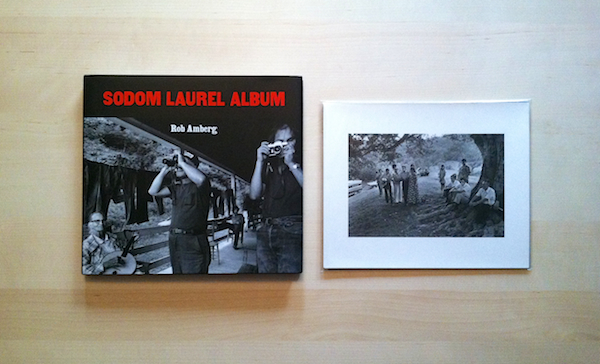 CONGRATULATIONS TO OUR WINNER - CHRIS FOWLER!
I'm happy to announce the giveaway of a signed copy of Rob Amberg's Sodom Laurel Album and a print from the original set of duotones selected for the book. The silver gelatin print, found on page 128 of the book, is Amberg's "Singing at the Grave Decoration, Rice Cove, Madison County, NC, 1977" and measures 5 x 7.5 (on 8 x 10 paper) and is signed, noted, and dated on the reverse.
For me, one of the most important things about the series Looking at Appalachia, is to collect work, stories, and conversations about Appalachian photographs as a way to foster discussion about how we look at Appalachia and what that means. Through conversations with photographers, by sharing their work and thoughts about Appalachia, and by examining issues of stereotype, place, and culture we can better understand this incredibly beautiful and complex place.
Rob Amberg's first book, which showcases his beautiful portraits and narrative of the Madison County, North Carolina hamlet, Sodom Laurel, is a hallmark of Appalachian photography.
To enter the drawing, visit Rob Amberg's website and go to the galleries section. Browse the galleries, find your favorite image, and copy the caption. Paste the caption, along with a description of why it's your favorite Rob Amberg photograph, in the comments section of this page. That's it! One person will be randomly selected from the submissions to receive the signed copy of Sodom Laurel Album and the print. The deadline for the giveaway is Friday, 7 December 2012, at 11:59 p.m. EST. The winner will be announced Saturday morning, 8 December 2012.
Nearly 1,000 new visitors have visited the blog since I posted the first part of Looking at Appalachia | Rob Amberg on 16 November 2012. Thanks to everyone who has visited, shared links through email and social media, and left comments on the blog. Please consider sharing this via social media and with your online photo communities.
Thanks!
Roger