Moonshine: A Conversation with Bertien van Manen
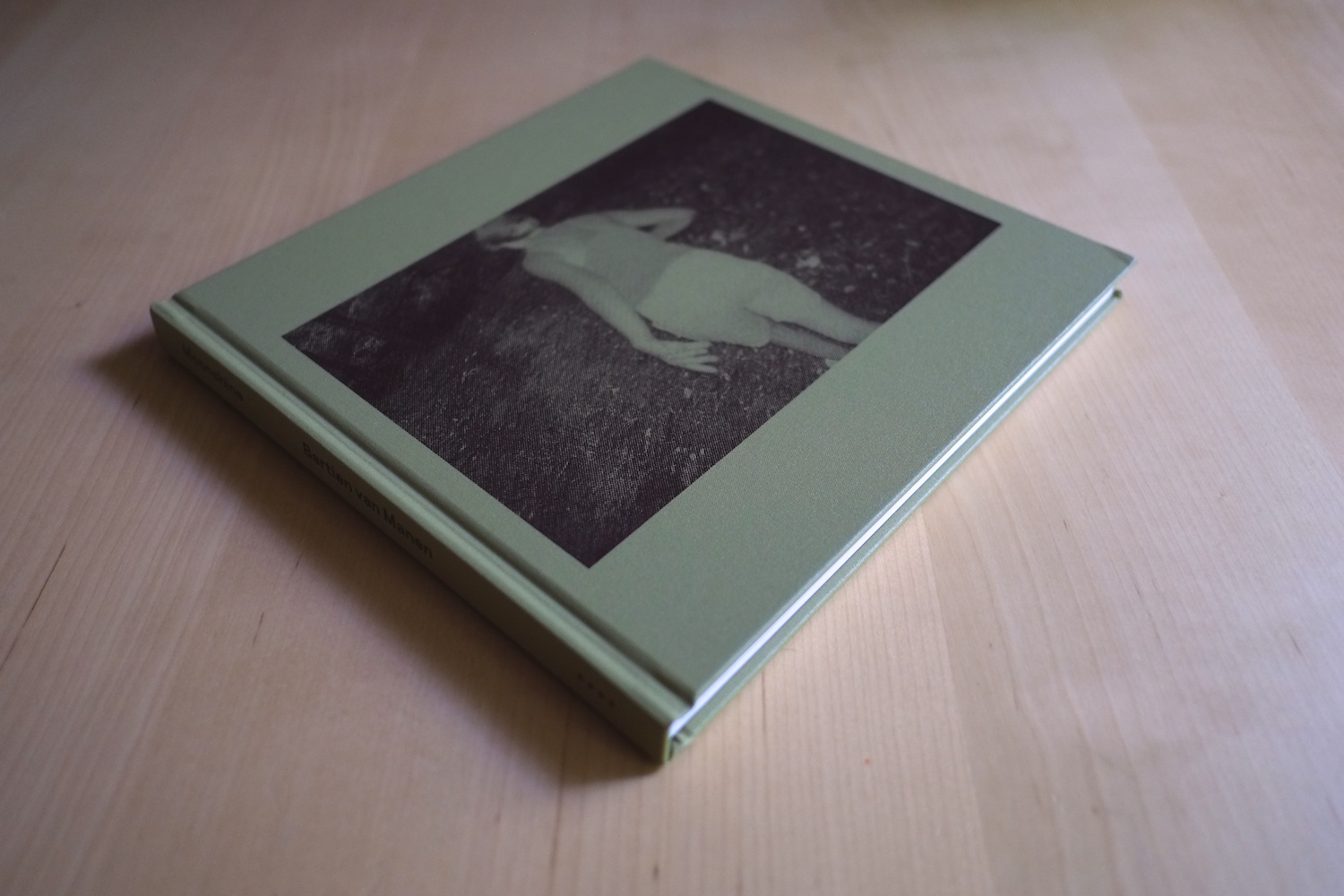
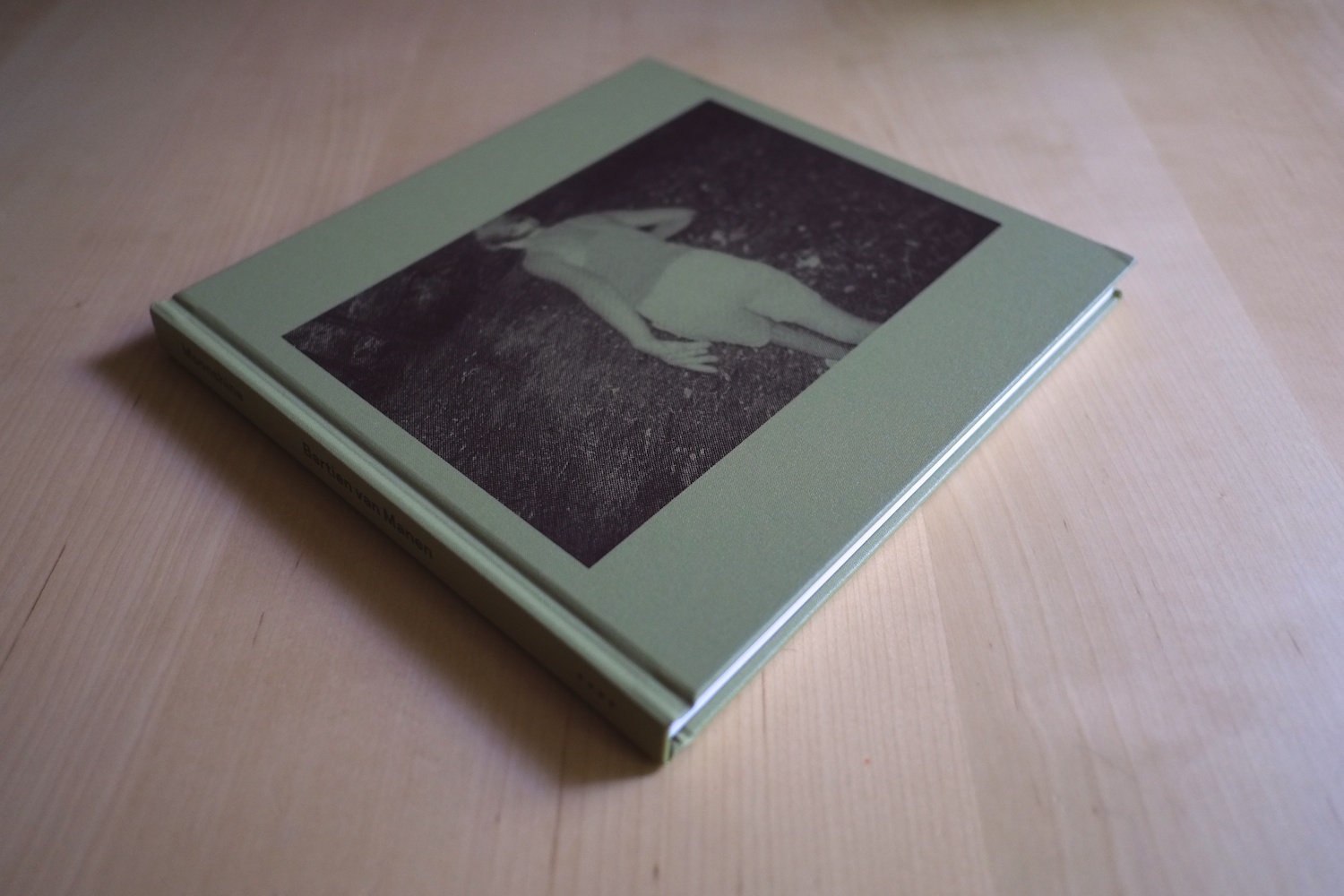
MACK recently released their third book with Dutch photographer Bertien van Manen. When I first heard the book's title, Moonshine, my thoughts were flooded with images of the hillbilly stereotype. I thought about the title for a while, but spent more time exploring why my first thoughts were negative and what role that plays in my own understanding.
As an Appalachian, I am quick to react to any perceived negative stereotype. I spend a good deal of time thinking and writing about and making work in Appalachia. It's also important for me to think about how to address these issues in ways that might further more of a conversation rather than shaking my fist. I feel that this in an important part in the evolution of the conversation about looking at Appalachia.
Rather than rant about the book or its title before literally ever seeing it, I decided to wait until I could spend some time with, read the photographer's notes, take in the pictures, and try to sort out how I feel about the work and what that means to me as both an Appalachian and a photographer. Admittedly, the first paragraph is hard choke down:
"Moonshine is the illegally produced, homemade whisky, which has been distilled in the American Appalachians for centuries, by light of the moon. Tucked away at the back of every refrigerator in Kentucky, Tennessee or West Virginia, you might find two or three large apple-juice bottles filled to the brim with what looks like water. The clearer the liquid, the stronger the alcohol content. There's nothing more hallucinating than Moonshine and reefers on a hot, sultry summer evening out on the porch, in the silence of the mountains, with only the zoom of the bug zapper or the twang of the hillbillies' voices rising as they grow merry."
See what I mean? For those of you seething at this point, I might point out the rather beautiful title I would've chosen for this body of work, in the very first sentence - by the light of the moon. But this is not my book and this not my work. This paragraph alone is filled with problematic language that recalls dozens of others images that perpetuate the visual Appalachian stereotype. Once can likely argue that this book offers no absence of them, however I am smitten by the power they hold for me. Yes, smitten. Guns, trailers, dogs, porches, knives, camouflage, and Jesus are found in these pages to be sure, but I also found family, beauty, grace, and childlike wonder. Wonder.
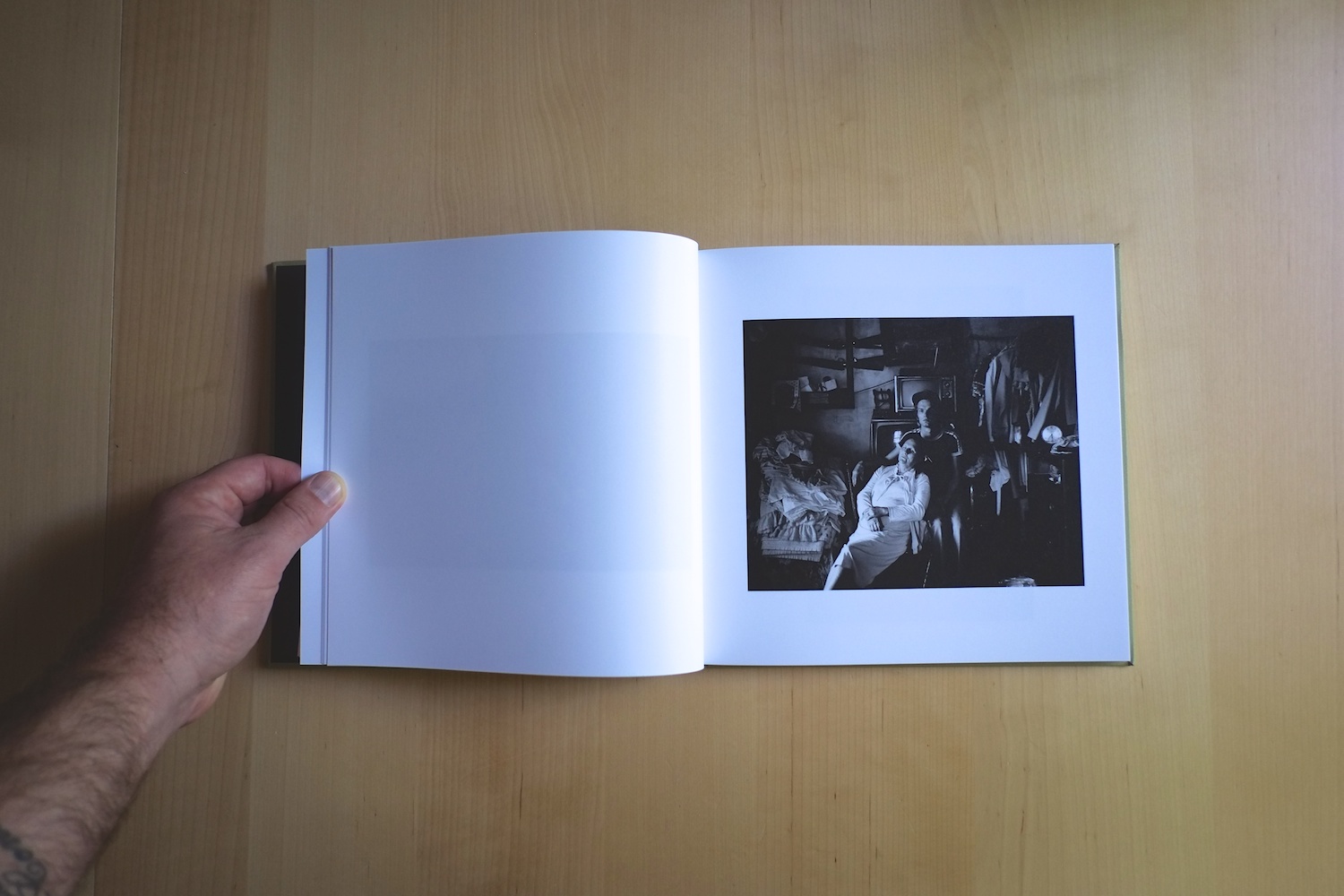
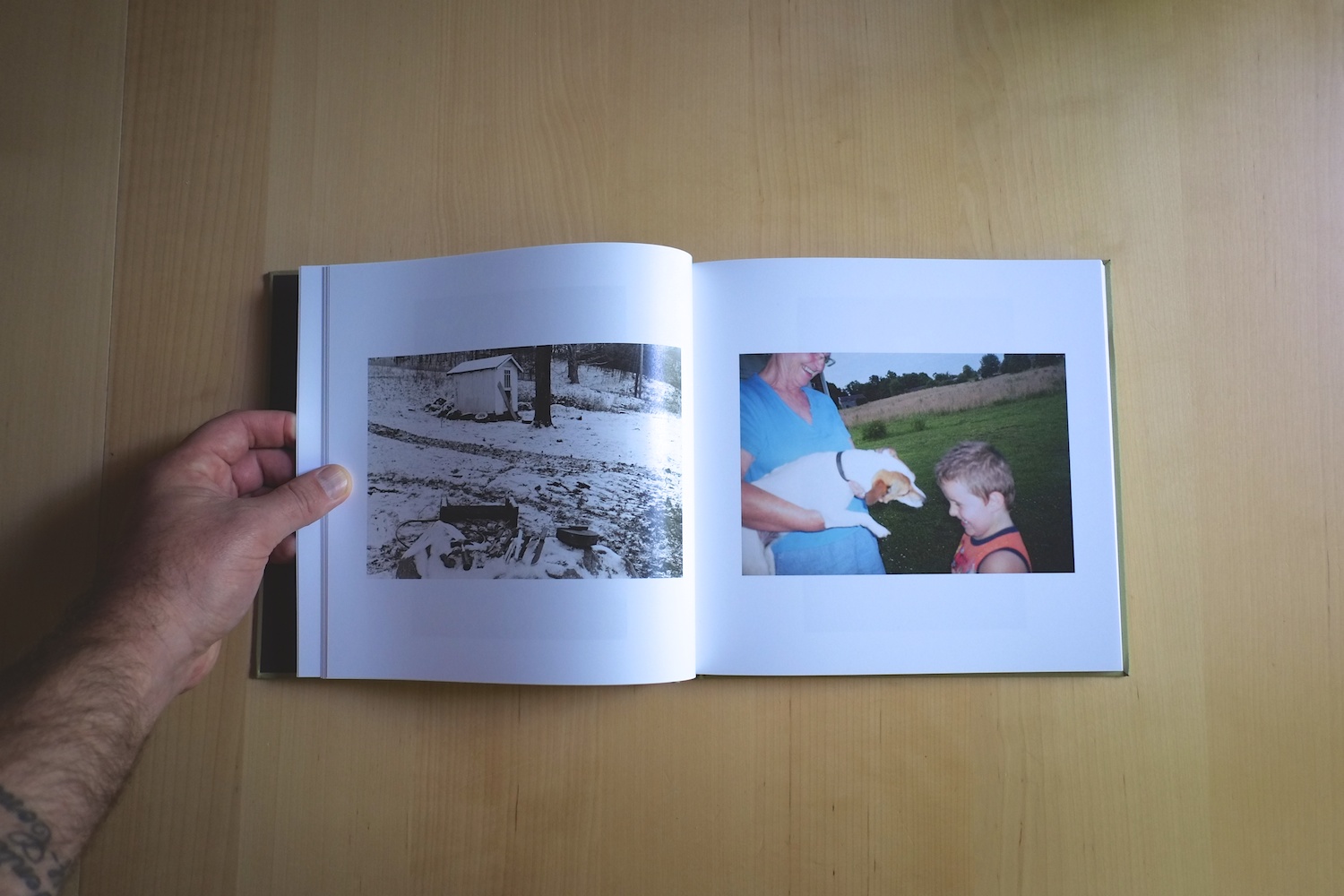
The first pass I made through the photographs, I wished I hadn't read the introductory text. For me, there is a clear separation between what is written - the literal - and what is represented in the pictures - far more subjective. Pictures mean different things to different people. We all have our own imprinting and bring a host of learned looking filters to how we see the world and all that's in it. I'm only writing about my own, which is all I'm qualified to do. For the span of time these photographs cover, I wanted more in the text. Instead, we are offered two pages with a few paragraphs noting the highlights of of each of van Manen's trips. With that said, this is a photobook about Appalachia not a novel. In fact, it's a photobook about a family in Appalachia, rather than about Appalachia. Despite the title, Moonshine is a fine photobook, beautifully printed, rich in the sort of access not often seen.
Not wanting to start and end this conversation in my head, I emailed Bertien van Manen and she graciously agreed to answer some questions about the work and her career.
Roger May: What connection led you to begin making work in Appalachia in 1985?
Bertien van Manen: Being raised in a coal-mining area in the south of Holland, I have a fascination for coal-mining and coal-miners. I went taking pictures in the coal mining area of west Yorkshire, in the UK, where I met Vic Allen, a professor in mining, who told me that he heard that in the Appalachian mountains women were working as coal-miners.
RM: Photographing people and the region of Appalachia can often yield unfair criticism, particularly in light of the flow of images that have been used to stereotype the region. Of course, this isn’t unique to Appalachia. People are stereotyped all over the world. How conscious were you of how the work might be interpreted and how much of that, if any, plays a role in how you make work?
BVM: I was very well aware of this, especially after I saw a photobook of a photographer of the region with the sort of images you probably have in mind. I was very much decided to avoid this way of working. At the time I was in close contact with the people of Appleshop in Whitesburg, who were very concerned.
RM: Can you talk about how the book’s title, Moonshine, came about? I’m sort of playing devil’s advocate here, but neither of your books made in parts of Russia - A Hundred Summers, a Hundred Winters and Let’s Sit Down Before We Go - were titled ‘Vodka.’
BVM: I never thought of that! It is true, of course. Moonshine was playing a role in people's life, there was a lot of partying going on. On the contrary, in Russia people drink out of sadness. The title "moonshine" came quite natural to me, it sounds poetic and mysterious, referring to moonshine in general.
RM: When Ron Jude told me about Moonshine a couple of months ago, I was excited to learn that 1) your commitment to this body of work spanned nearly three decades (with visits in 1985, 1987, 1988, 1996, 2007, and 2013) and 2) the notion that MACK was publishing a book specifically about Appalachia. Quite frankly, at first I took issue with the title because of my own filters and imprinting, which is problematic in and of itself, and where the the title of the book took me visually. It wasn’t until I spent some time with the work that it really began resonating with me. I see my own life and family in many of these photographs.
BVM: That is very nice to hear!
RM: Historically, your photographs seem very much about meeting people where they are, even learning their language (as in Russia). There is an unguarded quality in your pictures, which often reveal quiet moments and domestic chaos, often in close proximity of one another, which families tend not to reveal to just anyone, especially those with a camera. Can you talk about your work process?
BVM: Yes, especially the rather closed off communities in the Appalachian mountains! I am lucky to have some social intelligence. I am curious and I like being with people. I always live with the people I photograph, working with small, amateur cameras, trying not to be there so much as a photographer but rather as a friend, who happens to take pictures. People do not see me as threatening and once there is trust, most people like the attention they get from being photographed.
RM: How it has changed over the years? Do you see your work as a collaboration with the people in your pictures?
BVM: I don't think my way of working changed much over the years, for me it works well.
RM: Moonshine is your third book with MACK and your seventh solo book since 1994. How has the bookmaking process changed for you over time?
BVM: Making a book is like giving birth. It is sometimes painful but also a joy. All depends on the publisher. My current collaboration and relationship with Michael Mack is excellent.
RM: How do you work through the process of editing photographs you’ve produced for, in the case of Moonshine, nearly three decades?
BVM: I looked at all the contact-sheets and the artist and designer, Bas Geerts, did the same. Together we made the choice. I need a second eye to protect me from too much subjectivity as i know the people in the pictures so very well.
RM: You worked with Stephen Gill on your last book, Let’s Sit Down Before We Go. What was editing Moonshine like after that experience?
BVM: It went very well. Of course you have to trust the people you work with for one hundred percent.
RM: Can you talk about the importance of time as it relates to your photographs? One of the things I admire most about your work is its unhurried pace in terms of the span of time your projects take on. It would seem this requires a great deal of trust and vulnerability on both the people you’re photographing and you as the photographer.
BVM: I know this is a luxury. I received several grants to be able to work on this project, so I didn't have to worry about being able to survive. I need time to be able to show what I am looking for. I know what I am looking for and I am a perfectionist. I go on as long as I think I am not ready yet and as long as I still like what I am doing. I like to go back to places. I love to see the same people back and to discover this feeling is réciproque (translated mutual). It gives me the suggestion of belonging somewhere, be it temporarily. People feel that and act accordingly. It is a beautiful and serious game.
RM: How has this shaped your growth as an artist and human being over the course of your career?
BVM: This way of living has become a part of me. I have learned to be tolerant and easy.
RM: How has the book been received amongst those in the book?
BVM: I went to bring the book to Mavis in Kentucky. I was concerned about her not being in there that much. Or her children. That didn't seem to brother her that much. I had already written to her that it was not a family album. But the text was giving her difficulties, where I wrote about Junior shooting at her. "He can't defend himself any more," she said, which shows her deep-going solidarity.
Moonshine was printed in an edition of 3,000. In 2015 there will be an exhibition in New York with Yancey Richardson.




My Favorite Photobook Buys of 2013
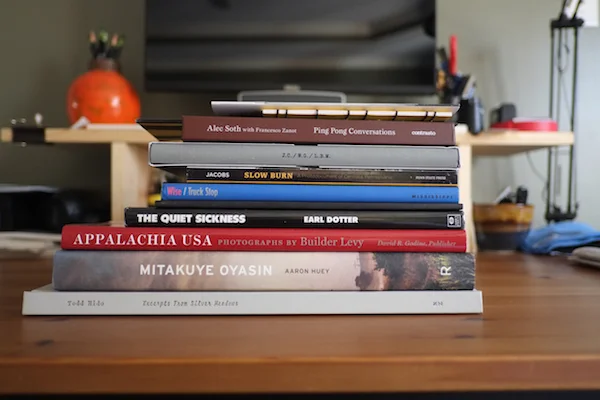
 Rather than a list of the top ten photobooks published in 2013, I thought I'd share my favorite eleven (because, you know, not ten) photobook acquisitions of the year. Some were released this year and some have been out for a while, but are new to me. So with that, my list in no particular order:

Electric Tears and All Their Portent by Jim Mortram. Café Royal Books, 2013. Jim has a heart bigger than the English Isles and it rings true in his photographs. We can all learn a lot from him.

Twelve Nashville Waffle Houses by Tammy Mercure. TCB Press, 2013. Tammy is one of the most prolific photographers working in Appalachia and the southeast today. She's a great person and hellabookmaker. I can't wait to see what she has lined up for 2014.

Ping Pong Conversations - Alec Soth with Francesco Zanot. Contrasto, 2013. Less photobook and more conversation, this quickly became one of my favorite books of the year. I appreciate photographers who talk about their work (and I think it's important to be able to talk about your own work) and Zanot creates a space for Soth to give us important background for many of his photographs (78 to be exact).

Iris Garden - stories by John Cage and photos by William Gedney. Little Brown Mushroom, 2013. It's no secret that I'm a huge admirer of William Gedney's photographs. Paired with writing by Cage and designed by Hans Seeger, I'll never be able to reassemble this book the way it was put together (it's not bound), but whatever. It's just beautiful.
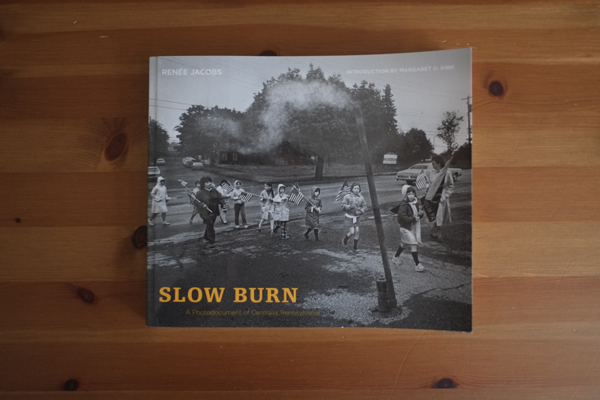
Slow Burn: A Photodocument of Centralia, Pennsylvania by Renée Jacobs. Penn State Press, 2010. I've wanted this book for a while now as I've been fascinated by the story of Centralia. When I went to Jacobs' website to look for it, I couldn't find it, but instead found some beautiful nudes. After some digging, I found a copy via the publisher. It's the epitome of what I look for in a photobook about place: maps, smart layout, and a balance of photographs by the observer and text/interviews with people in the community.

Truck Stop by Marc F. Wise. University Press of Mississippi, 1995. Hat tip to Bryan Shutmaat for recommending this one. If you don't own it, you should. I'm pretty sure an entire class could be based on this book.

Rough Road: The Kentucky Documentary Photographic Project (1975-1977) by Bill Burke, Bob Hower, and Ted Wathen. Quadrant Incorporated, 2011. Thanks to John Edwin Mason for bringing this fantastic project to my attention. I called Ted Wathen last week and ordered this amazing little book. I'm going to be chasing Bill Burke in 2014.
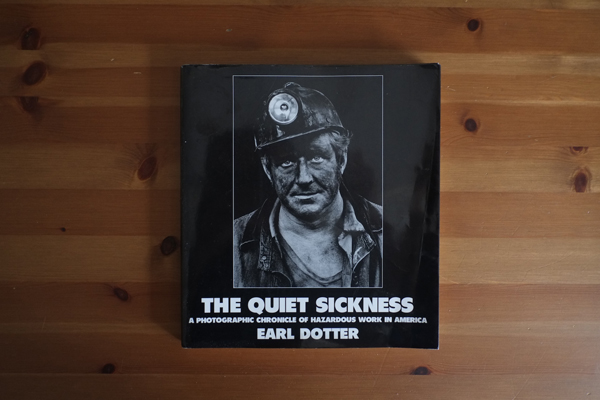
The Quiet Sickness: A Photographic Chronicle of Hazardous Work in America by Earl Dotter. American Industrial Hygiene Association, 1998. I'll thank Rob Amberg for introducing me to Earl Dotter's work. After I sat with this book for a while, I began to see Dotter's work everywhere. Powerful and poetic.
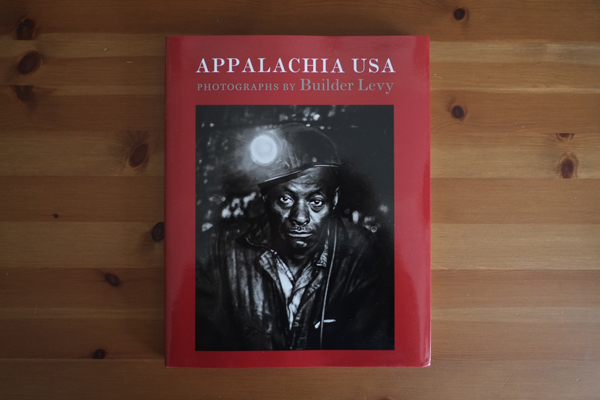
APPALACHIA USA by Builder Levy. David R. Godine, 2013. I've admired Builder's work for years now. He recently sent me his latest book, APPALACHIA USA, with a beautiful inscription. The miner pictured on the cover, Toby Moore, worked at the same mines (I believe) as my grandfather, Cecil May. I can't recommend this book enough.

Mitakuye Oyasin by Aaron Huey. Radius Books, 2013. Beautifully printed, designed, and bound. Be prepared to have your eyes opened to a part of America few people like to talk about, much less see. I can't thank Huey enough for guiding us there and reminding us that this country was founded at a tremendous cost, one that's still being exacted.
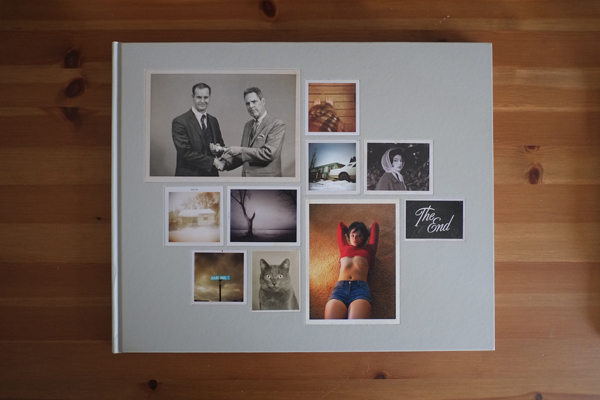
Excerpts from Silver Meadows by Todd Hido. Nazraeli Press, 2013. Thanks to Susan Worsham for convincing me to get THE LAST available copy at LOOK3 earlier this year and for standing in line with me to get Hido to sign it.

Holler Ghosts, Bookmaking, and Such
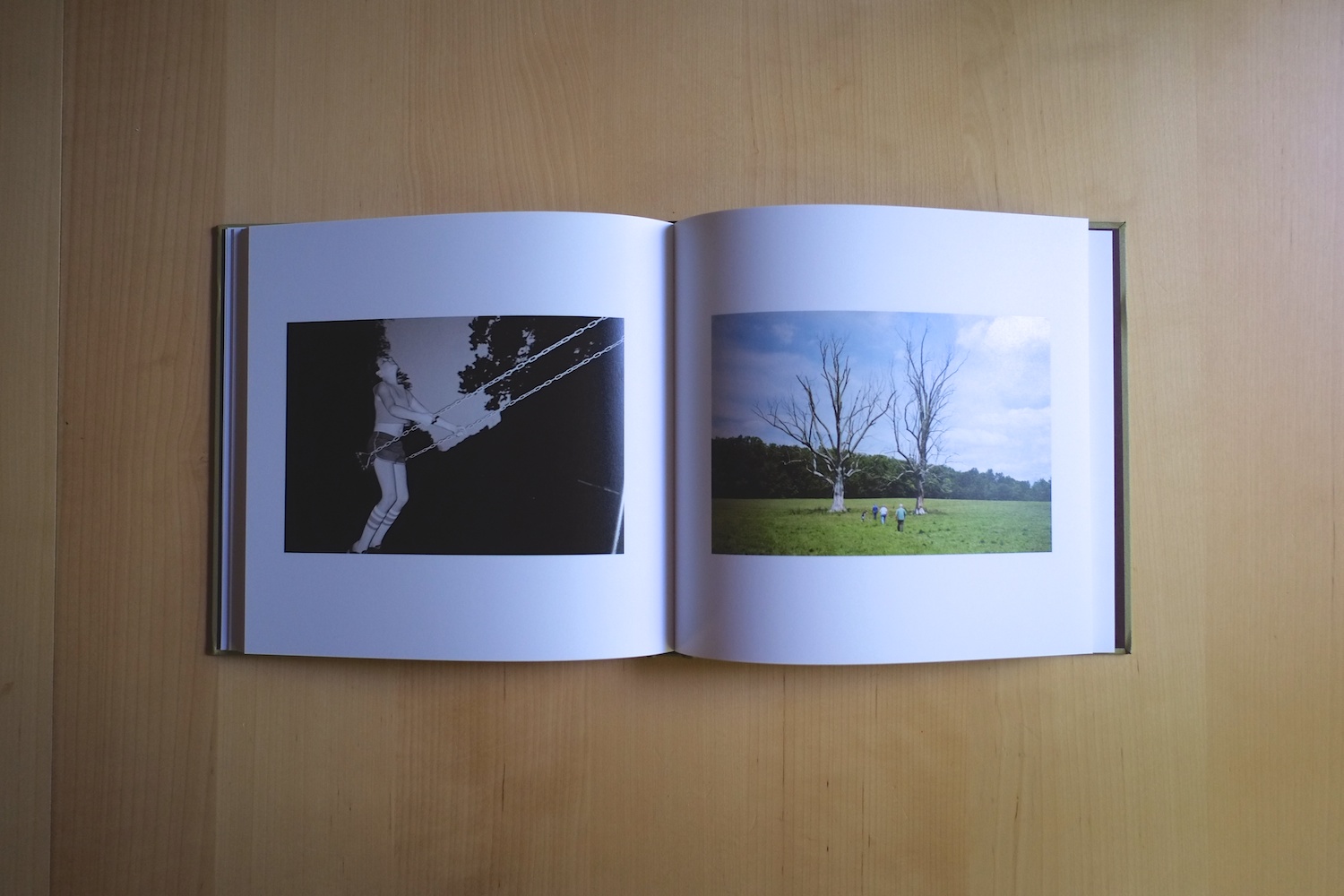
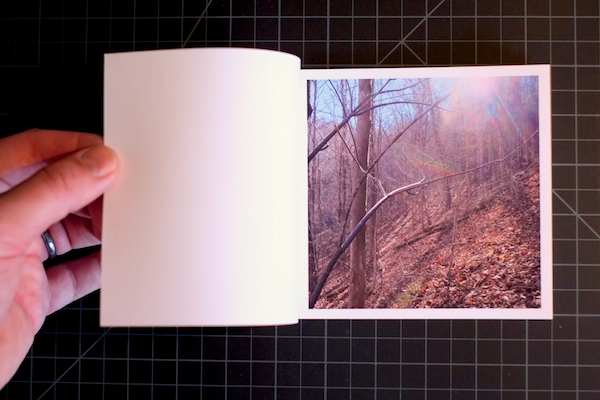
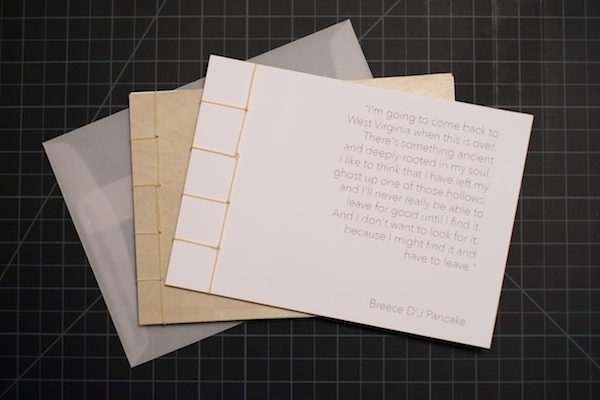 I spent some time playing around with making a couple of books this weekend. I made this one as a Christmas present for my in-laws. I took a walk on a crisp winter morning on their property in Elgood, West Virginia and made a series of square photographs (using the Fuji X-Pro1's in-camera setting). There's something especially beautiful about walking their holler this time of year. I chose nine photographs to print (using Inkpress Media duo matte 80) along with a quote from one of my favorite writers, Breece D'J Pancake. This was my first attempt at binding a book and I can't believe how much fun it was. It measures 5" x 7". I made a second one using 1/32" birch plywood for the cover, not realizing it wasn't really flexible enough to practically use as a book cover. I'll chalk that one up to inexperience...
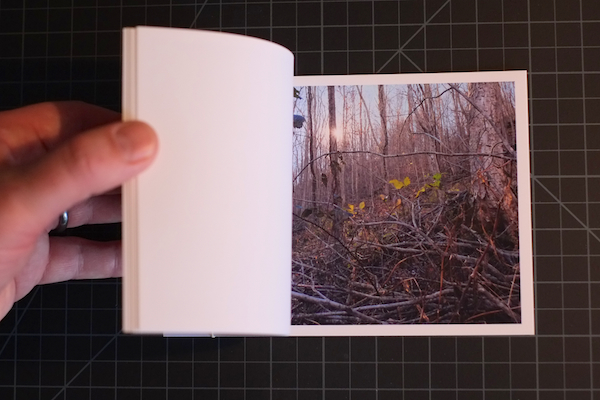
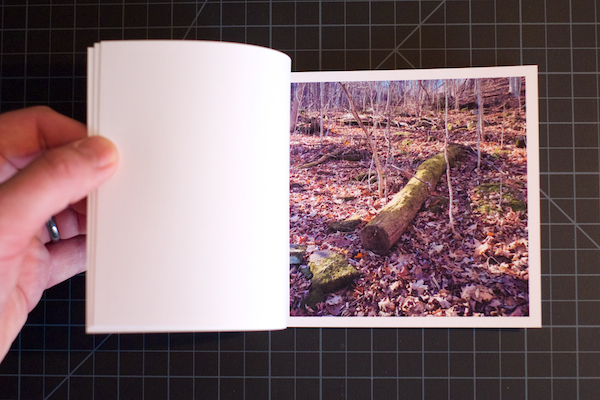
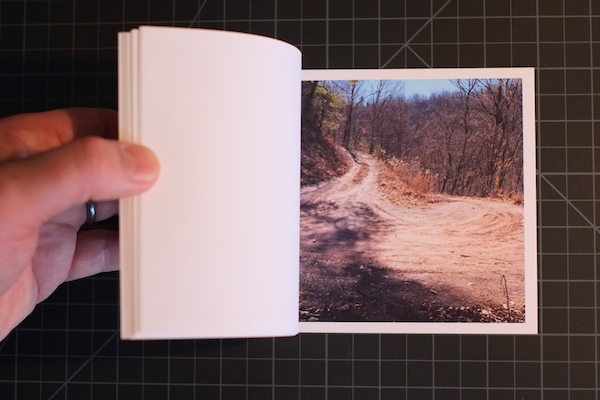
“I'm going to come back to West Virginia when this is over. There's something ancient and deeply-rooted in my soul. I like to think that I have left my ghost up one of those hollows, and I'll never really be able to leave for good until I find it. And I don't want to look for it, because I might find it and have to leave." - from a letter to his mother Helen Pancake that Breece wrote in Charlottesville, where he was studying writing.

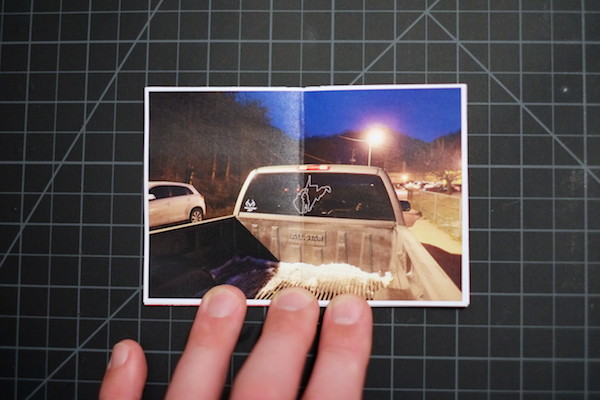
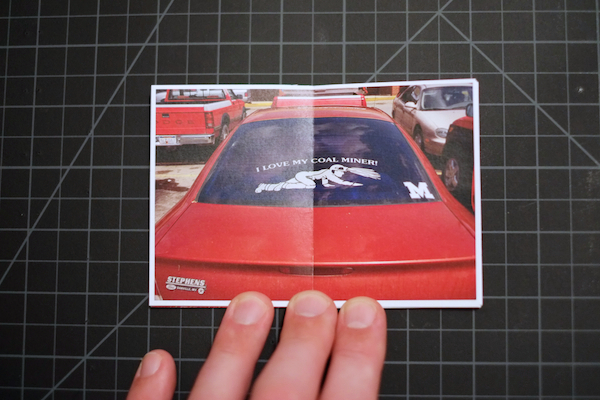
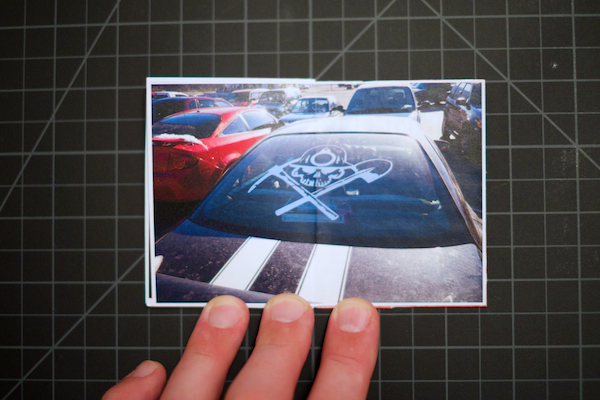
This little book measures 2.5" x 3.5" and is based on a new series I'm working on called Miner Pride. It's a crudely made book, printed on a color laser printer and I made the cover from an Ilford paper box top cut to size. I used double-sided tape to hold the pages together and a strip of masking tape to bind the covers. Such simple materials yielded an incredible amount of fun. That's what it's all about, right? (I also made a little video here.)
Holler.
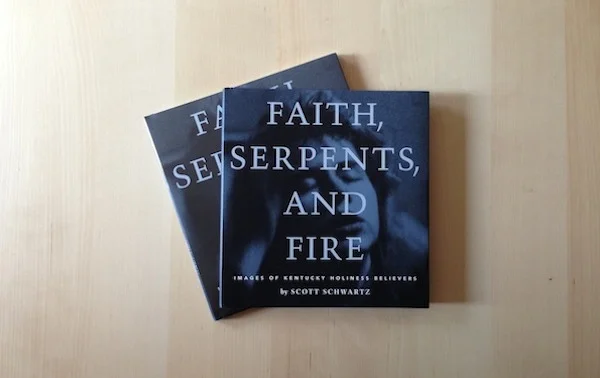
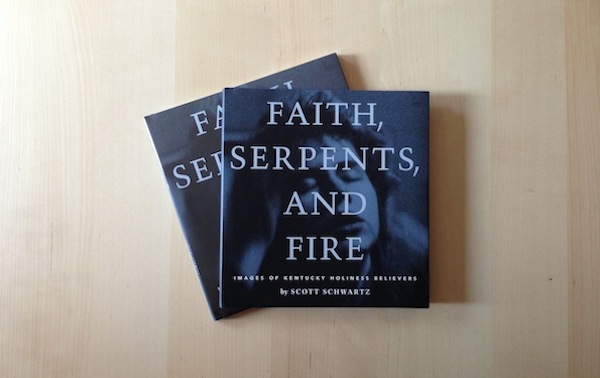
Review: Faith, Serpents, and Fire: Images of Kentucky Holiness Believers
 CONGRATULATIONS TO OUR WINNER – CAROLYN PARKER!
Hardcover| 9.5 x 9 inches | 128 pages | 88 black and white photographs University Press of Mississippi, 1999 | Scott Schwartz
"And these signs shall follow them that believe; In my name shall they cast out devils; they shall speak with new tongues; They shall take up serpents; and if they drink any deadly thing, it shall not hurt them; they shall lay hands on the sick, and they shall recover." Mark 16:17-18, King James Version
As far back as I can remember, well before picking up a camera, I've been fascinated by the serpent-handling faith. This religious tradition has long been ridiculed and used as an example to highlight the Appalachian backwoods stereotype. I've wanted to photograph these services for a while now and though I'm far from the religious upbringing of my Appalachian childhood, I look forward to making some pictures later this summer. Why? I'm simply fascinated by an obedience that would call one to take up a serpent as an act of worship. I'd like to photograph these services as a celebration of faith and tradition.
I picked this book up at the 2013 Appalachian Studies Conference in Boone, North Carolina. At the same time, I was reading Dennis Covington's fabulous 1995 book Salvation on Sand Mountain: Snake Handling and Redemption in Southern Appalachia (which Schwartz lists in his bibliography). One of the more striking passages from Convington's book is below, and as a photographer, I've mentally substituted 'photographer' for 'writer' and found it to be especially true:
"I believe that the writer has another eye, not a literal eye, but an eye on the inside of his head. It is the eye with which he sees the imaginary, three-dimensional world where the story he is writing takes place. But is also the eye with which the writer beholds the connectedness of things, of past, present, and future. The writer's literal eyes are like vestigial organs, useless except to record physical details. The only eye worth talking about is the eye in the middle of the writer's head, the one that casts its pale, sorrowful light backward over the past and forward into the future, taking everything in at once, the whole story, from beginning to end."

Before I continue, I should let you know that if you're expecting technically superb, sharp images from Schwartz's book, you'll be sorely disappointed. What the book lacks in technical merit, it more than makes up for with the supplemental text and depth of the work in its entirety.
Schwartz notes in the introduction:
"The photographs were taken with 35mm, 400 ASA film, without flash, in an effort to intrude as little as possible upon the services. As a result, the film was "push-processed" two and three stops. The pronounced grain and the strient patterns of light in these images are the result of this process and of my desire to have the photographs represent the mood of the spiritual experiences. The photographs and essays record the complex and sometimes humorous social interactions that I encountered and provide an intimate glimpse into serpent-handling practices and beliefs, moving beyond the stereotypes of Appalachian snake charmers and fire eaters to illustrate the deeply personal and communal spirituality that is an integral element of the services."

It's clear to me that though Schwartz took a scholarly approach to the fieldwork conducted for this book, much like Covington's journalistic approach to Salvation on Sand Mountain, both men experienced far more than they bargained for. I don't think it was an accident that I discovered these two books at roughly the same time I'm doing prep work for my own experience with this community. Together, these books have helped reinforce my interest in the subject and my desire to add another voice to the conversation.
Schwartz writes, "Everything seems so natural, yet the media's blitz about a recent serpent-handling fatality paints a much darker and more sinister picture of these people. However, I am drawn by a brighter image." It's usually then, and only then, that the media's attention is on this tradition. It's important to note that this isn't a widespread Appalachian religious tradition contrary to popular belief. However, when there's a fatality, such as Mack Wolford's in West Virginia last year, the notion that serpent handling is a common part of worship in rural churches throughout Appalachia is once again perpetuated.

Another passage from Salvation on Sand Mountain:
"It's not true that you become used to the noise and confusion of a snake-handling Holiness service. On the contrary, you become enmeshed in it. It is theater at its most intricate - improvisational, spiritual jazz. The more you experience it, the more attentive you are to the shifts in the surface and the dark shoals underneath. For every outward sign, there is a spiritual equivalent. When somebody falls to his knees, a specific problem presents itself, and the others know exactly what to do, whether it's oil for a healing, or a prayer cloth thrown over the shoulders, or a devil that needs to be cast out."

If you'd like a chance to win a copy of Faith, Serpents, and Fire: Images of Kentucky Holiness Believers, please leave your name, city, and state in the comments field by midnight EST, Friday, 26 April 2013. I'll select a winner at random the following day.