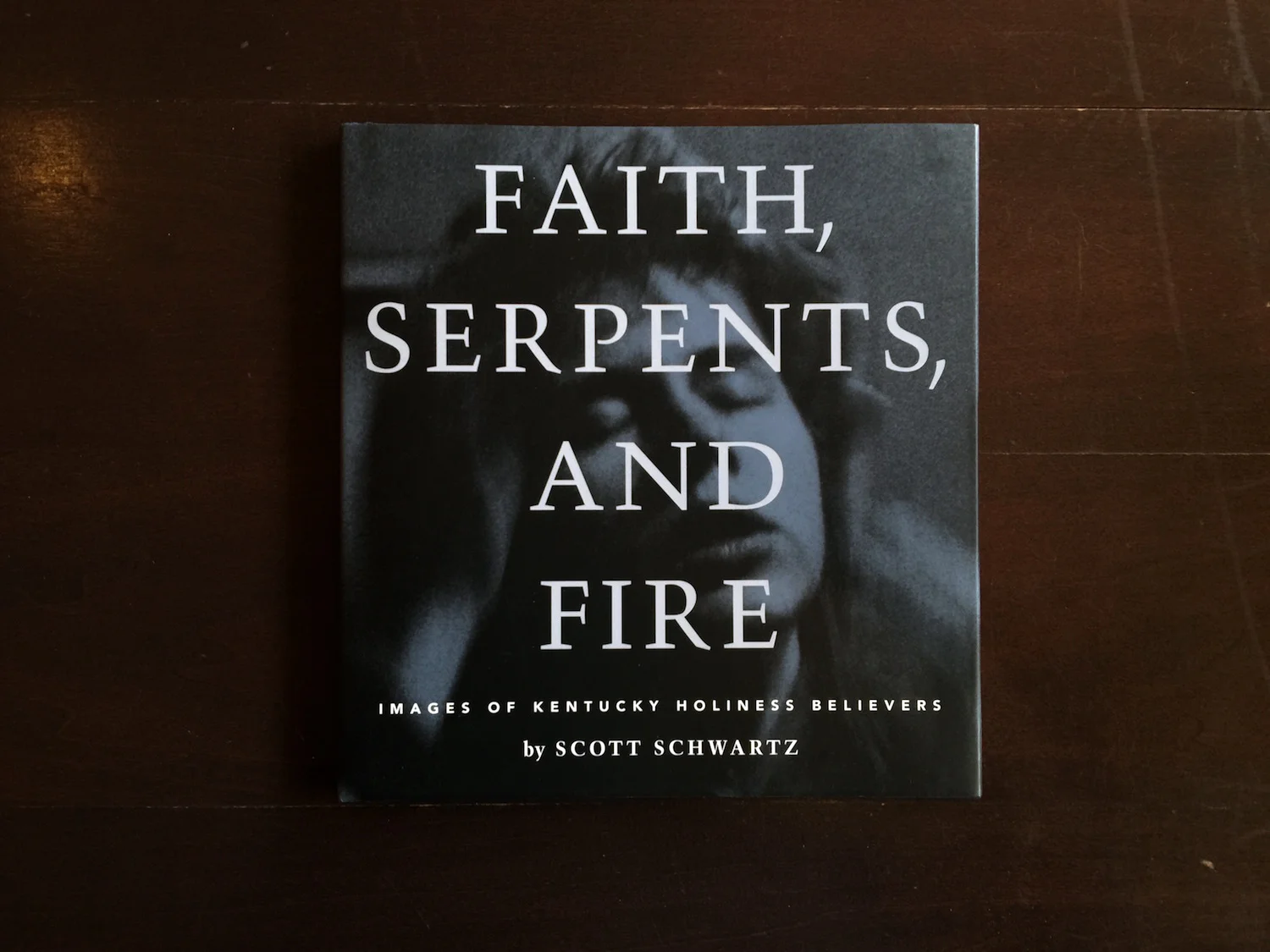
Review - Faith, Serpents, and Fire: Images of Kentucky Holiness Believers

Hardcover| 9.5 x 9 inches | 128 pages | 88 black and white photographs | University Press of Mississippi, 1999 | Scott Schwartz | $25
"And these signs shall follow them that believe; In my name shall they cast out devils; they shall speak with new tongues; They shall take up serpents; and if they drink any deadly thing, it shall not hurt them; they shall lay hands on the sick, and they shall recover." Mark 16:17-18, King James Version
As far back as I can remember, well before picking up a camera, I've been fascinated by the serpent-handling faith. This religious tradition has long been ridiculed and used as an example to highlight the Appalachian backwoods stereotype. I've wanted to photograph these services for a while now and though I'm far from the religious upbringing of my Appalachian childhood, I look forward to photographing in this community at some point. Why? I'm simply fascinated by an obedience that would call one to take up a serpent as an act of worship. I'd like to photograph these services as a celebration of faith and tradition.
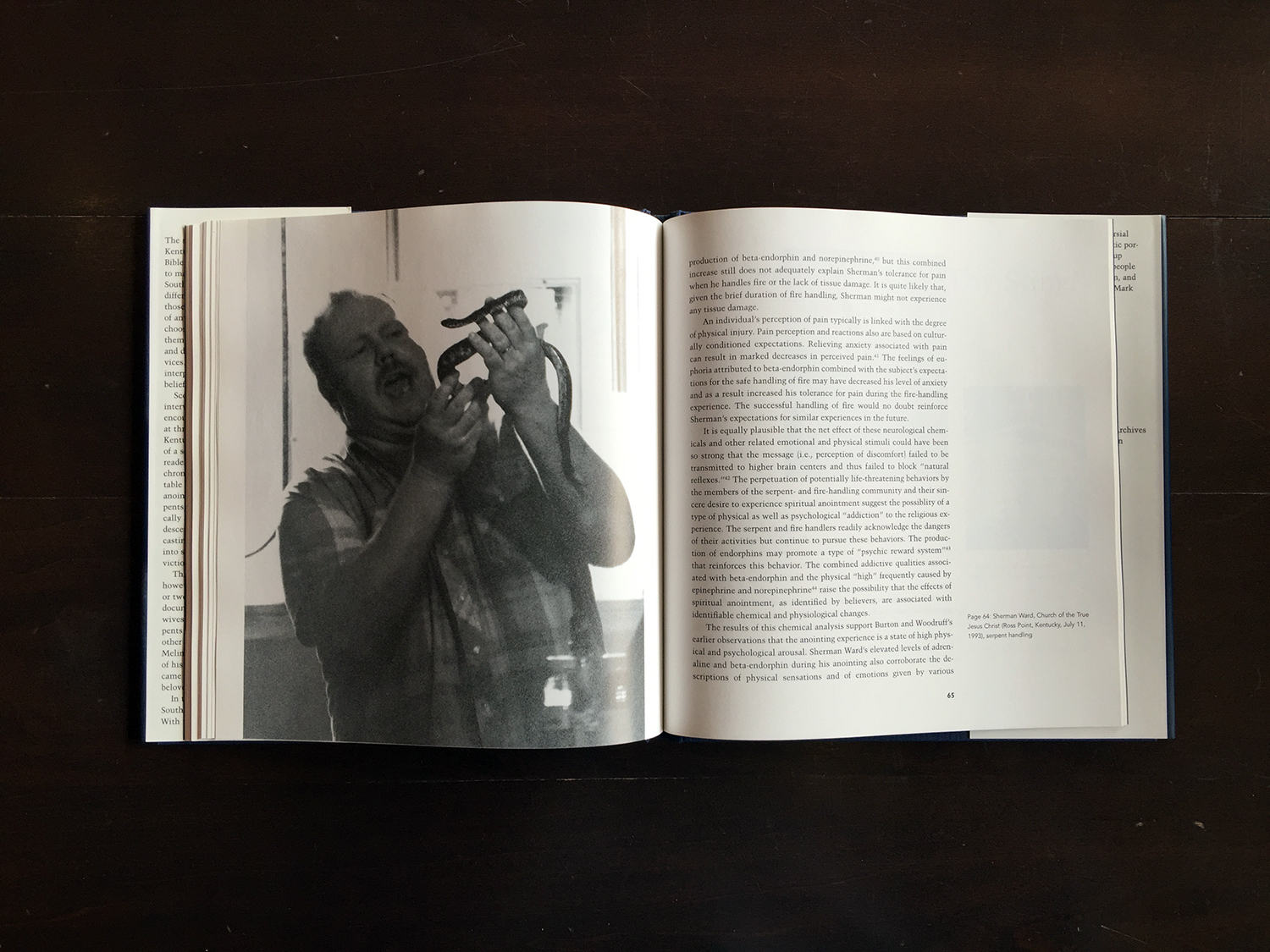
It's important to not just view this book as a serpent-handling album. Schwartz goes much deeper, writing at length about other pentecostal holiness practices, which are equally as fascinating to me: speaking in tongues, foot washing, and singing are just as much a part of this book as serpent handling. And Schwartz is surprisingly reflective about his time spent documenting these practices (from 1992 to 1994). He writes, "I think about how pervasive the music is, about how every cell in your body is shocked by a spiritual presence, about how the handling of serpents and the anointing are seamless. The music and the Holy Spirit are at one. Where does the music stop and the spiritual anointing begin?"
I picked this book up at the 2013 Appalachian Studies Conference in Boone, North Carolina. At the same time, I was reading Dennis Covington's fabulous 1995 book Salvation on Sand Mountain: Snake Handling and Redemption in Southern Appalachia (which Schwartz lists in his bibliography). One of the more striking passages from Convington's book is below, and as a photographer, I've mentally substituted 'photographer' for 'writer' and found it to be especially true:
"I believe that the writer has another eye, not a literal eye, but an eye on the inside of his head. It is the eye with which he sees the imaginary, three-dimensional world where the story he is writing takes place. But is also the eye with which the writer beholds the connectedness of things, of past, present, and future. The writer's literal eyes are like vestigial organs, useless except to record physical details. The only eye worth talking about is the eye in the middle of the writer's head, the one that casts its pale, sorrowful light backward over the past and forward into the future, taking everything in at once, the whole story, from beginning to end."

Before I continue, I should let you know that if you're expecting technically superb, sharp images from Schwartz's book, you'll be sorely disappointed. What the book lacks in technical merit, it more than makes up for with the supplemental text and depth of the work in its entirety. I appreciate the level of detail in the captions, too. Each caption includes an exact date and location.
Schwartz provides some detail about his photographic process in the introduction:
"The photographs were taken with 35mm, 400 ASA film, without flash, in an effort to intrude as little as possible upon the services. As a result, the film was "push-processed" two and three stops. The pronounced grain and the strient patterns of light in these images are the result of this process and of my desire to have the photographs represent the mood of the spiritual experiences. The photographs and essays record the complex and sometimes humorous social interactions that I encountered and provide an intimate glimpse into serpent-handling practices and beliefs, moving beyond the stereotypes of Appalachian snake charmers and fire eaters to illustrate the deeply personal and communal spirituality that is an integral element of the services."

It's clear to me that though Schwartz took a scholarly approach to the fieldwork conducted for this book, much like Covington's journalistic approach to Salvation on Sand Mountain, both men experienced far more than they bargained for. I don't think it was an accident that I discovered these two books at roughly the same time I began researching this community with hopes of making pictures. Together, these books have helped reinforce my interest in the subject and my desire to experience the community firsthand.
Schwartz writes, "Everything seems so natural, yet the media's blitz about a recent serpent-handling fatality paints a much darker and more sinister picture of these people. However, I am drawn by a brighter image." It's usually then, and only then, that the media's attention is on this tradition. It's important to note that this isn't a widespread Appalachian religious tradition contrary to popular belief. However, when there are fatalities, such as Mack Wolford in West Virginia in 2012 and Jamie Coots in Kentucky in 2014, the notion that serpent handling is a common part of worship in rural churches throughout Appalachia is once again perpetuated.
Another passage from Salvation on Sand Mountain:
"It's not true that you become used to the noise and confusion of a snake-handling Holiness service. On the contrary, you become enmeshed in it. It is theater at its most intricate - improvisational, spiritual jazz. The more you experience it, the more attentive you are to the shifts in the surface and the dark shoals underneath. For every outward sign, there is a spiritual equivalent. When somebody falls to his knees, a specific problem presents itself, and the others know exactly what to do, whether it's oil for a healing, or a prayer cloth thrown over the shoulders, or a devil that needs to be cast out."
I think this is a fine addition to any collection of books about Appalachia and highly recommend it.

(Editor’s note: a version of this review appeared on my blog on 14 April 2013. I bought several copies of this book for $5 each at the Appalachian Studies Association conference. Used copies can be found online for a similar price.)
Review - New Deal Photographs of West Virginia 1934-1943

Hardcover| 8 x 9.5 inches | 240 pages | 150 black and white photographs | West Virginia University Press, 2012 | $29.99
(Editor's note: a version of this review appeared on my blog on 2 December 2012. I received a free review copy from West Virginia University Press.)
Between 1934 and 1943, ten photographers: Elmer “Ted” Johnson, Walker Evans, Ben Shahn, Arthur Rothstein, Carl Mydans, Edwin Locke, Marion Post Wolcott, John Vachon, John Collier, Jr., and Arthur Siegel, visited West Virginia as part of Roy Stryker’s Farm Security Administration (FSA) photographic unit. The FSA’s primary attention during this time was on the northern and southern coalfields, the three subsistence homestead communities (Arthurdale, Eleanor, and Tygart Valley), and two wartime assignments in Nicholas and Mason counties.
What Betty Rivard, a retired social worker and planner for the state of West Virginia, offers in this beautifully presented book, is a collection of images by photographers (whose work I know well) of West Virginia at a time I never knew. I’m fascinated with how others see my home state. None of these photographers are from West Virginia, yet they managed to capture its essence, its livelihood. Perhaps one of the things I appreciate most about these pictures is that they were made at a time when photographs weren’t nearly as a prevalent as they are today (Instagram, Facebook, and the like). Unlike the War on Poverty images of Appalachia, these pictures were made with a different intent, a different tone. I sense a true collective effort to document the people and stories of West Virginia when I look at these photographs and think about the photographers who made them. Rivard notes that, “The photographs in this book offer professional fine art photographs in support of these memories, snapshots, and stories.”
She continues:
“It is beyond the scope of this book to explore why, especially in the past fifty years, the state became a poster child for a culture of poverty. Unfortunately, the media have focused on poverty and exaggerated backwoods-type images as representative of West Virginia. These images have left terrible scars on a number of people who have grown up in the state. They also continue to bring harm through the perceptions that some outsiders have formed of the state and its citizens.”
Rivard does a more than fair job of including images from a variety of the photographers as well as the regions covered. As a Mingo County native, I was somewhat disappointed to not see any photographs of Williamson or outlying areas included in the Southern Coalfields section, given Mingo’s rich coal heritage and importance in the labor movement. But I admit my bias and am including an image below (not in the book) by Ben Shahn made in Williamson in 1935. Logan and McDowell counties are well represented in pictures by Ben Shahn and Marion Post Walcott.

New Deal Photographs of West Virginia is a brilliant book, extremely well edited and designed. The photographic reproductions are sharp and well printed and with every image, the Library of Congress negative file number is included, which makes finding them online incredibly easy. I hope in the few years since this book was published that every county library and school in West Virginia has a copy. It is a treasure, and not in photographs alone. I can only hope for a second volume.
Betty Rivard is an award-winning fine art landscape photographer. She has researched and coordinated three exhibits of FSA photographs of West Virginia and contributed to articles about the FSA Project to Wonderful West Virginia, Goldenseal, and West Virginia South magazines. She is a Social Worker Emeritus and traveled to every county in West Virginia during her 25-year career as a social worker and planner with the state.
Here are a few of my favorites from New Deal Photographs of West Virginia:
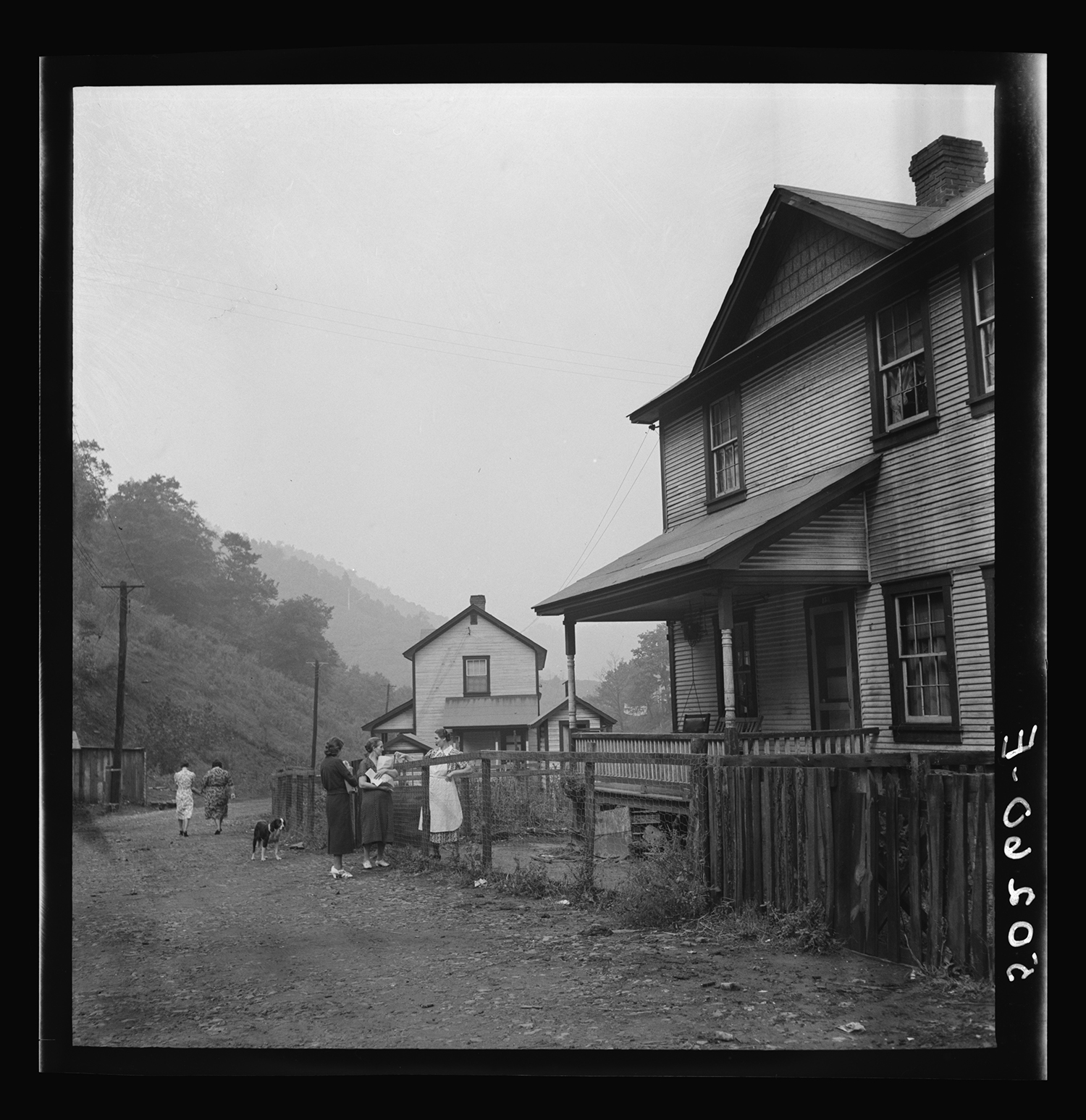
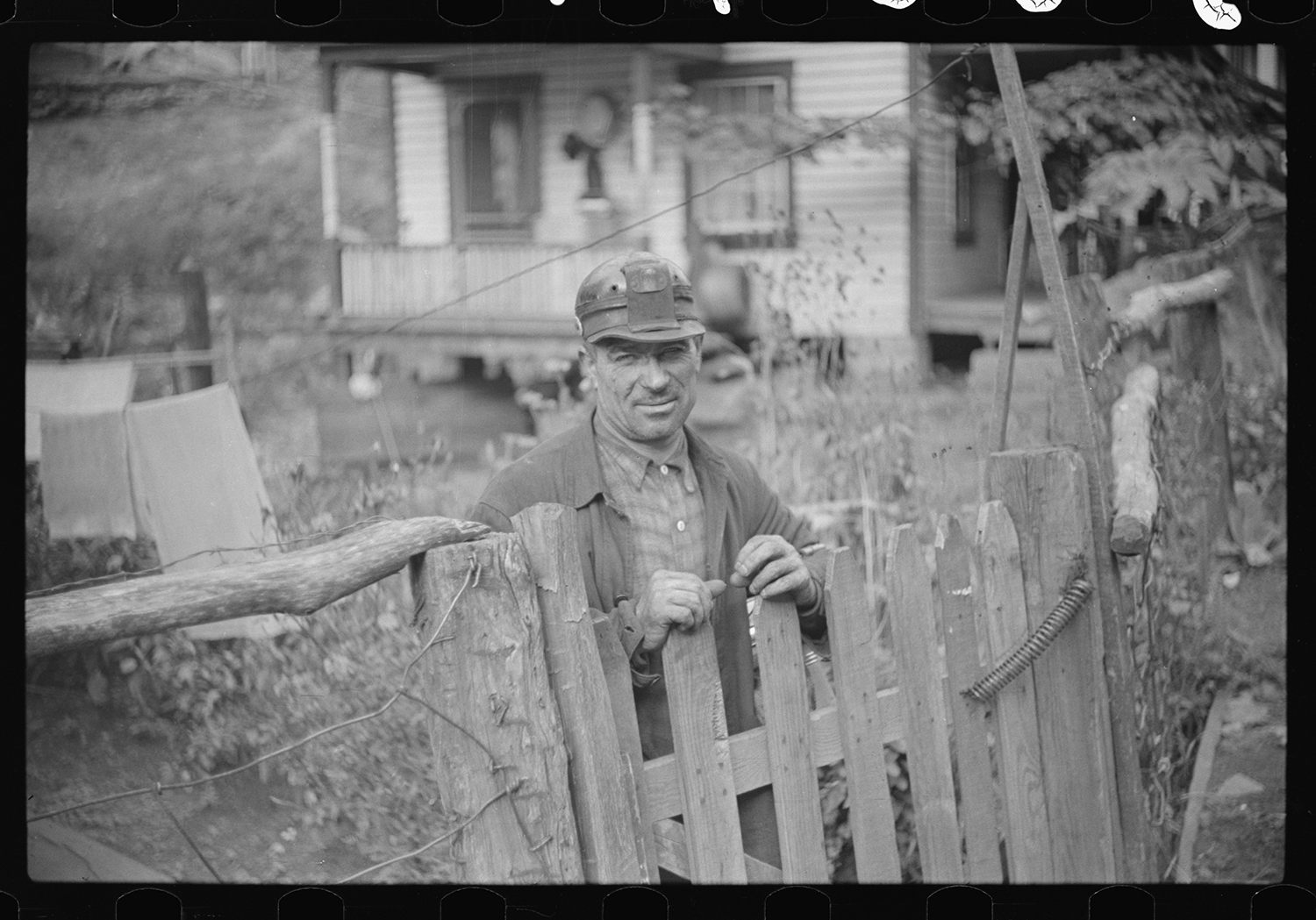

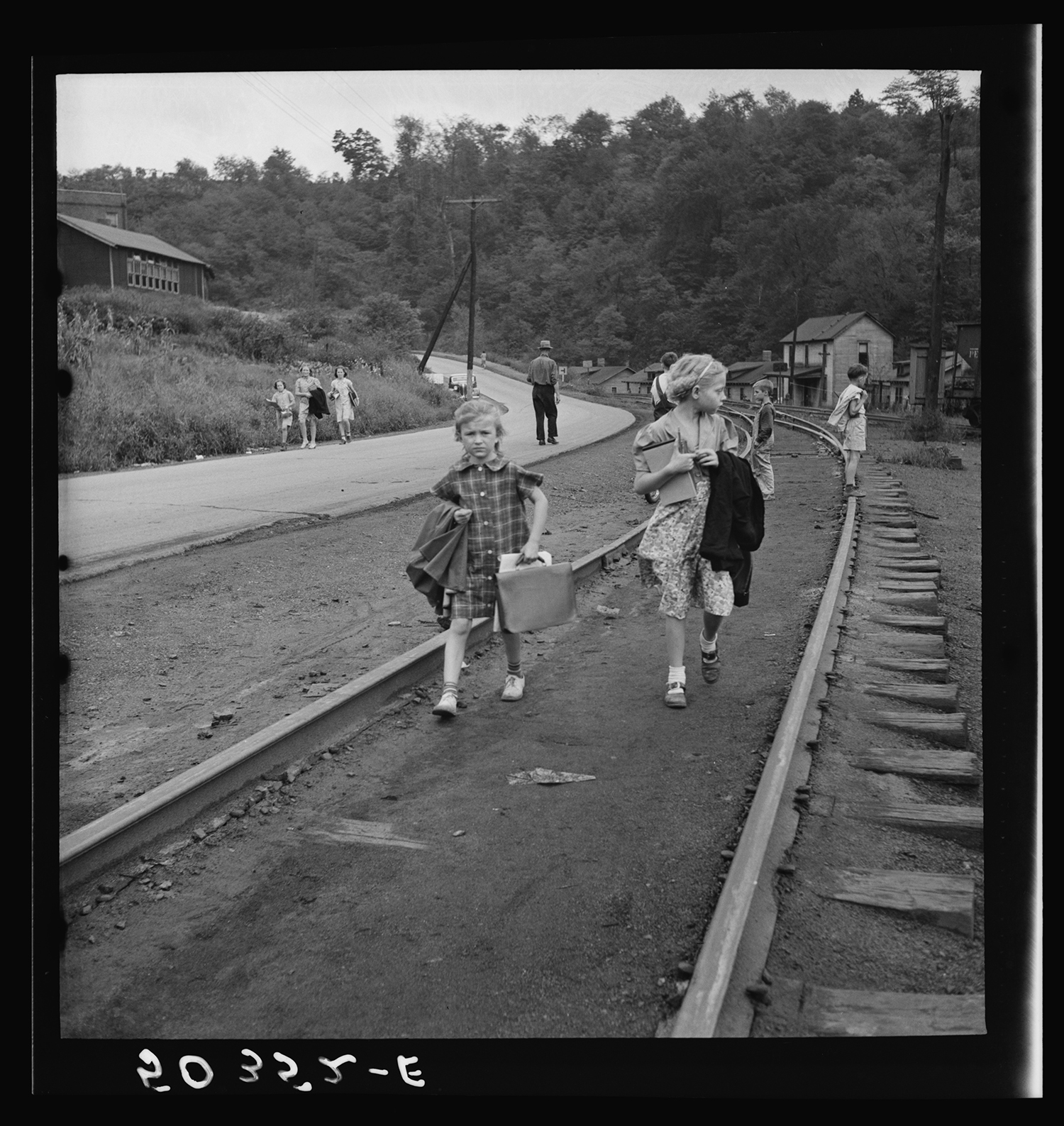
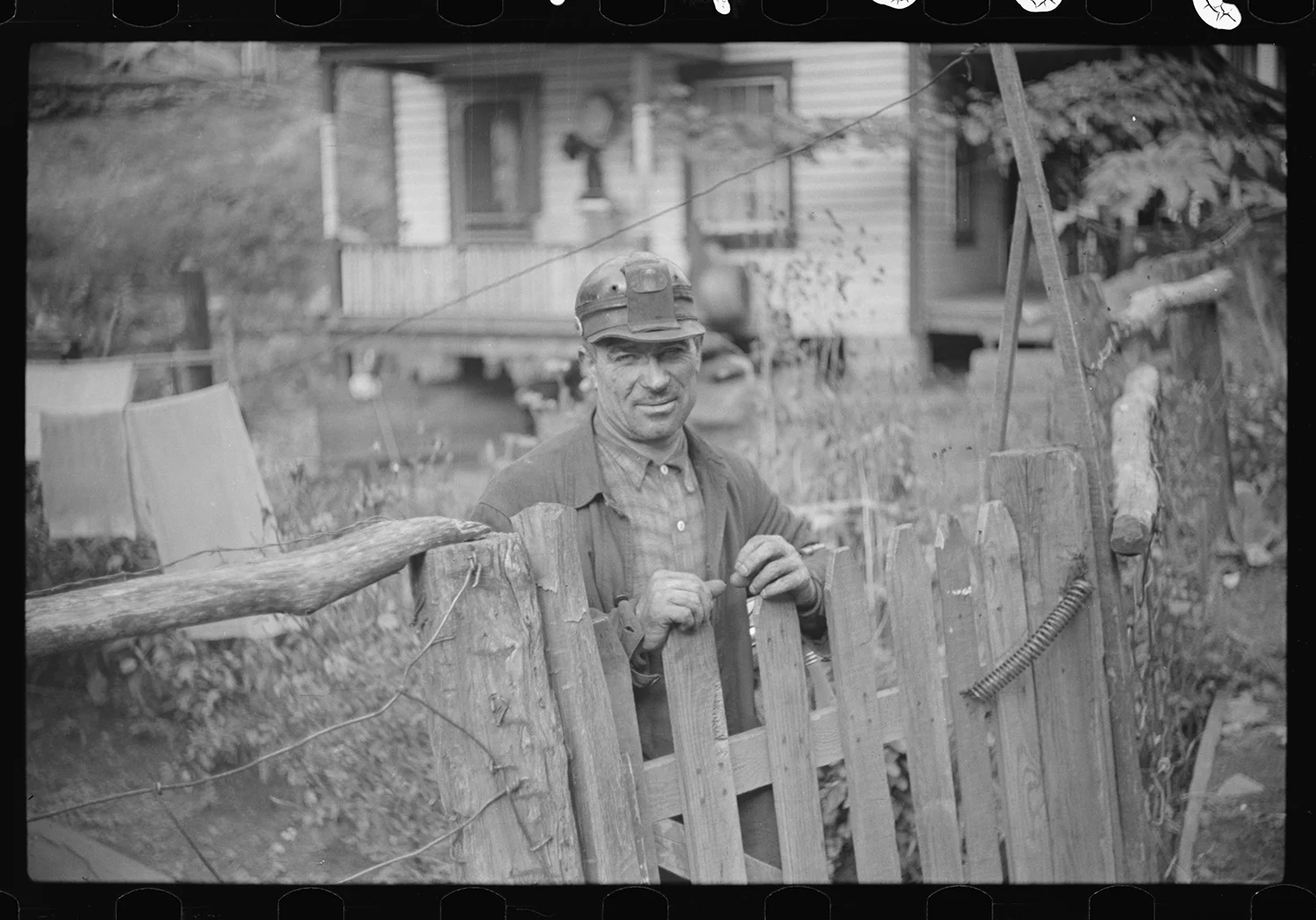
1. Wives of coal miners talking over the fence. Capels, West Virginia. Marion Post Wolcott. September 1938. LC-USF34-050260-E. 2. Miner (Russian). Capels, West Virginia. Marion Post Wolcott. September 1938. LC-USF33-030077-M1. 3. Men in Sunday clothes with miners’ clubhouse in the background. Omar, West Virginia. Ben Shahn. October 1935. LC-USF33-006200-M1. 4. Coming home from school. Mining town. Osage, Scotts Run, West Virginia. Marion Post Wolcott. September 1938. LC-USF34-050352-E.
Very special thanks to Elaine McMillion, director of Hollow: An Interactive Documentary, for arranging a review copy of New Deal Photographs of West Virginia.
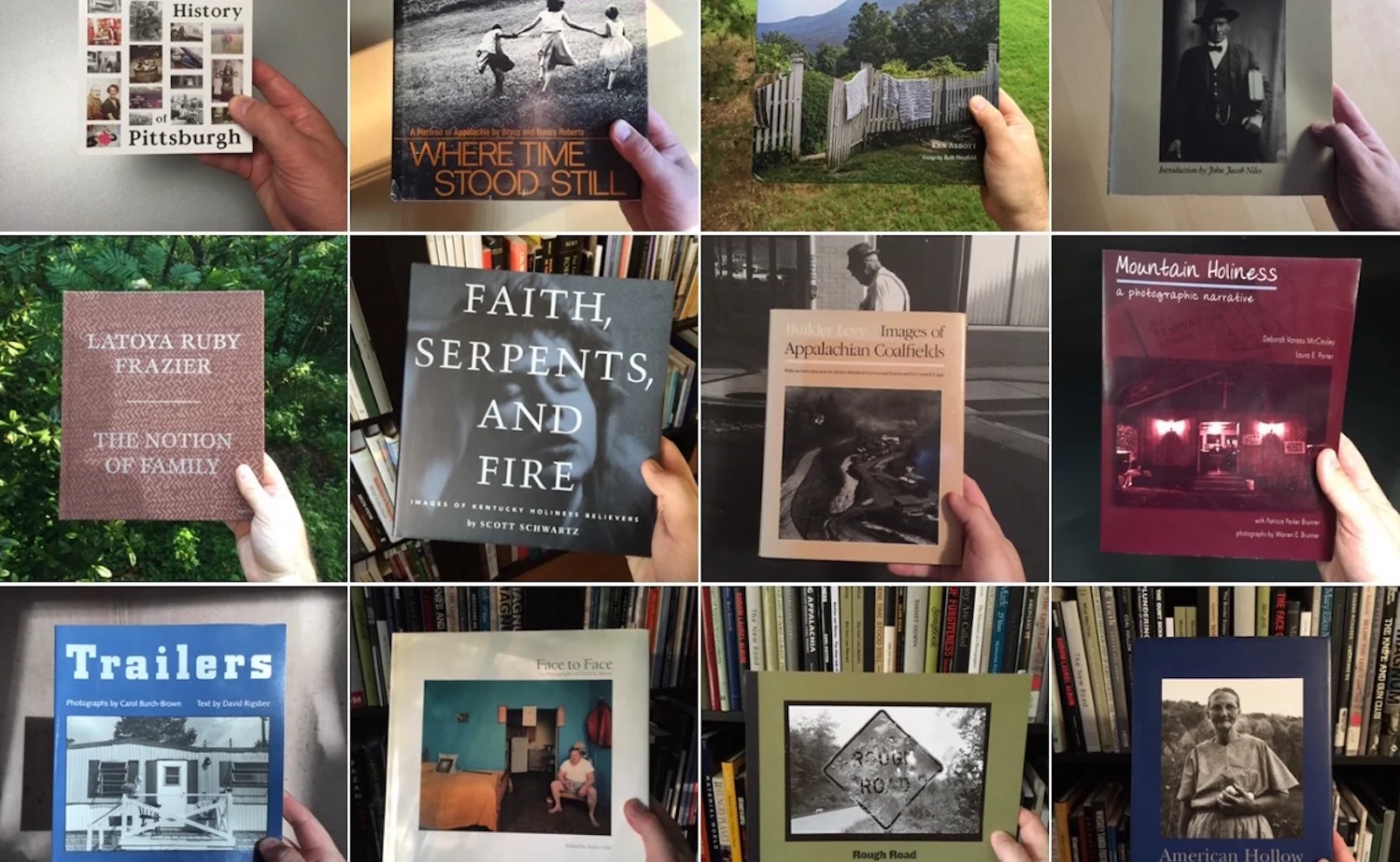
Appalachia Photobook Friday - Expanded

In 2015, I started sharing photobooks about Appalachia via Instagram every Friday (well, almost every Friday). I wanted to use the photo-based social media platform to share some of the books from my collection and to sometimes deliver some brief thoughts about them. My collection isn't large by any means, but some of these books have had a profound impact on me as a photographer and as an Appalachian.
I love the tangible nature of books. Even today, with digital cameras, iPads, and everything being digital, I still prefer to read the paper, to handle prints, and to spend time with books, especially photobooks. There's something romantic to me about handling a book, spending time with it, noticing something on the third or fourth look that I missed on the first. Photographs live so differently in books that they do online or even on walls. There's something about the pace of looking through a book, being able to put it down and pick it up again that I find comforting and I connect with. Books are an art in of themselves.
In an effort to dig a bit deeper and formulate my thoughts a bit about each of these books, I plan to write a more in-depth, opinionated review here. Like the Appalachia Photobook Friday Instagram posts, I'll plan on publishing a review of each book on a Friday. My goal will be to keep the reviews under a thousand words, give or take, and to make this series available as a resource to anyone interested. In the interest of full disclosure, if books have been sent to me for review or as gifts, I'll state that clearly. I won't get anywhere near as in-depth as Jörg Colberg does over at Conscientious, but I'll be clear about my opinion and thoughts on each book.
I've been excited about the conversations started as result of me posting these books to Instagram. I'm also excited to discover new books, so if you'd like to recommend one, please do.
(Below is a screenshot of how the books appeared in my Instagram feed, but please note that I won't be posting reviews in any particular order.)

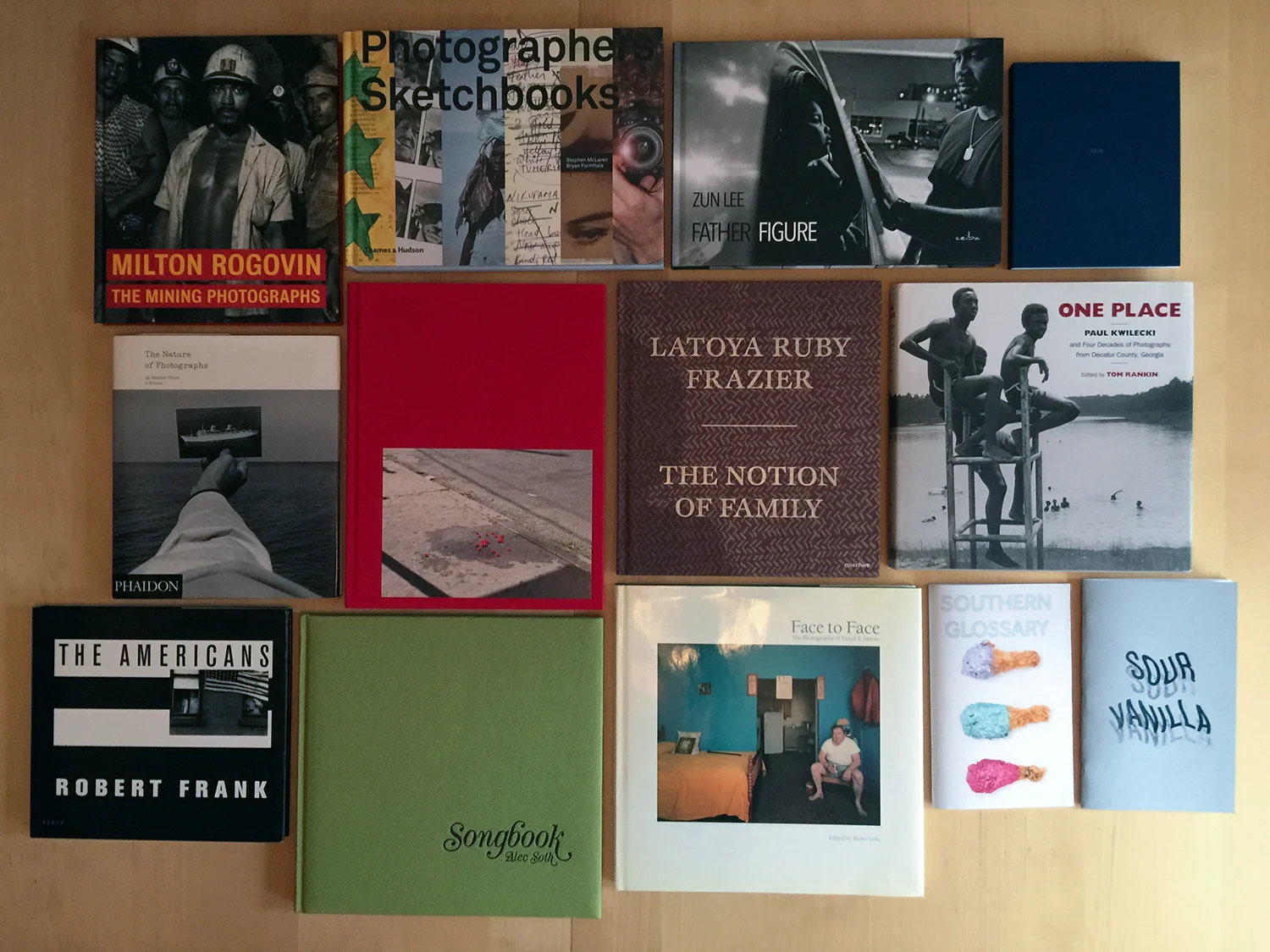
My Favorite Photobook Buys of 2015

I'm not a fan of "best of the year" lists, but a couple of years ago, I wrote a piece about my favorite photobook acquisitions of the year. Like Christmas decorations, these ridiculous lists start to appear earlier and earlier each year. As with most lists, the "best photobooks of the year" lists are entirely subjective as is this one. What I prefer to do is list the photobooks that have had a significant impact on me as a photographer, writer, and photobook collector and to share some thoughts on each one.
I buy used photobooks when I can. I like to think of where these books have lived before arriving on my shelves, who might've thumbed through the pages in awe or perhaps boredom, and how they might've moved someone else to see the world differently. I buy some books new in the likelihood they'll go out of print (because of such "best of" listicles, which means perhaps I'm contributing to the problem). I've only ever intentionally bought two brand new copies of the same book with the intent on leaving one in the shrink wrap.
I believe photobooks are meant to be handled, pored over, hell, even obsessed over. I love trying to figure out how sequences work (or don't), how text works with (or against) the photographs, and the solitude of leafing through the finished "thing" a photographer has dedicated so much time to putting into the world. So, on with my list of favorite photobook acquisitions of 2015.

The Notion of Family | LaToya Ruby FrazerAperture, 2014, 156 pages.
LaToya Ruby Frazer has had a pretty incredible year and deservedly so (last year included a Guggenheim Fellowship). She was the recipient of the ICP Infinity Award, a MacArthur Grant, a $625,000 prize distributed over five years, and named a TED Fellow. Her first book, The Notion of Family, was published by Aperture last year and is centered on her hometown of Braddock, Pennsylvania (which is in Appalachia). The book is beautifully produced and is a testament to family, identity, and vision. This book is hands down my favorite photobook acquisition of the year.
"Informed by documentary practices from the turn of the last century, Frazier explores identities of place, race, and family in work that is a hybrid of self-portraiture and social narrative. The crumbling landscape of Braddock, Pennsylvania, a once-thriving steel town, forms the backdrop of her images, which make manifest both the environmental and infrastructural decay caused by postindustrial decline and the lives of those who continue—largely by necessity—to live amongst it." - LaToya Ruby Frazier

One Place | Paul KwileckiUniversity of North Carolina Press and CDS Books of the Center for Documentary Studies, 2013, 272 pages. There are many books dedicated to detailing the lives of conflict photographers, but I can't think of many that focus on four decades of photographing one county. That's right, one county. "I confine myself to the place I was born and raised, not as an arbitrary discipline or to prove that subjects worthy of photographs exist everywhere and in abundance, though it is true that they do, but because Decatur County (Georgia) is home," Kwilecki wrote, "and I know it from my special warp, having been both nourished and wounded by it." His photographs are astounding and show us community fabric in pictures in a way only one can who is so intimately familiar with home can, warts and all as the'd say. With no formal photographic training, Kwilecki began making pictures around 1960. He photographed the deep south, black and white folks, and pursued the notion of home with true passion. Kwilecki's work and the resulting book, published a few years after his death in 2009, have heavily influenced my thought process on making work in Mingo County, West Virginia.
Father Figure | Zun LeeCeiba, 2014, 124 pages. I met Zun Lee at LOOK3 earlier this year and asked him to sign my copy of Father Figure. I don't know that I've ever met a more humble and joyful person. There's so much heart in this book, I can't possibly capture it here. This work strikes a chord with me as a father, but further it's deeply moving to me as someone who grew up without my biological father being in the picture for most of my childhood. All I ever wanted to be was a dad, a good dad. This work is passionate, intimate, and as Jamel Shabaaz describes it, "visual medicine." It challenges stereotypes and asks us to acknowledge men who are all too often dismissed in the media. Teju Cole writes in the introduction, "These are images of love, which is an elusive subject, an almost impossible subject. There is an affection for life in these photographs, an affection for Black life, for fatherhood and childhood, for the tender moment that will soon be gone."

The Nature of Photographs | Stephen ShorePhaidon, 2007, 136 pages. Stephen Shore is arguably one of America's preeminent voices in photography and a pioneer of color work. I've found this book to be invaluable, a great find at a local used bookstore. Shore writes, "In bringing order to this situation, a photographer solves a picture, more than composes one," alongside a photograph made by Nicholas Nixon in Friendly, West Virginia in 1982 (one of my favorites in the book). Though not incredibly lengthy in text, its provides succinct, thoughtful meditations on the photographic works of William Eggleston, Helen Levitt, Berenice Abbott, and many others.
TIS01 | This is Sausage (TIS) BooksTIS Books, 2015, Set of four books, edition of 300 (between 48-60 pages per book). I have to say these folks are up to something really good. I can't quite put my finger on what it was, but when I saw this series launch earlier this year, I wanted to get this set of books and I couldn't have been happier. The books are by four different photographers: Tim Carpenter, J Carrier, Nelson Chan, and Carl Wooley, but I love the fact they're all produced in the same color, size, binding, and relative length. Each carries its own unique narrative and theme, but work incredibly well as a set. They're the sort of books you'd be thrilled to have one of, but knowing they're a set of four makes it that much better. There is virtually no text save for the colophon in each of the books, which I find to be well suited for an edition this size. TIS Books is making some great photobooks and I hope that by this time next year, I'll be writing about their production of Steven B. Smith's Waiting Out the Latter Days.

The Mining Photographs | Milton RogovinGetty Publications, 2005, 144 pages. Before I even get to the Rogovin photographs, I'd be remiss if I didn't mention the incredibly wonderful introductory essay by Judith Keller. I think it should be required reading for anyone interested in long form work in Appalachia. She writes, "Rogovin's study of community extended beyond neighborhoods in his own northeastern city. With the collaboration of his wife, Anne, a special-education teacher, he undertook a lengthy investigation of Appalachia mining communities, returning to small towns in West Virginia and eastern Kentucky each summer from 1962 until 1971. Through union contacts he found the mines and recorded the men at work. Anne assisted in getting acquainted with the general population; Milton photographed them on their porches, in their yards, on the sidewalks, and in their homes."
In addition to Appalachia, Rogovin photographed miners in Scotland, Germany, China, Mexico, Zimbabwe, Cuba, and Czechoslovakia. The Rogovins were friends with the late Dr. Donald Rasmussen, a well-known authority on black lung disease, who passed away earlier this year in West Virginia. Throughout this beautifully edited book, Rogovin captures the pride, dignity, and spirit of the often-overlooked miner. It is a true testament to the working class.
Photographers' Sketchbooks | Stephen McLaren and Bryan FormhalsThames & Hudson, 2014, 320 pages. The list of photographers the duo of McLaren and Formhals enlisted for this books is staggering: Roger Ballen, Jason Eskenazi, Stacy Kranitz, Susan Meiselas, and Alec Soth just to name a few. McLaren writes, "To explore the 'photographic sketchbook' in all its various forms is in one sense a legitimate return to photography's earliest role in the fine arts." He continues, "Photography may be having a bit of a Babel moment, so our intent here is to let the reader see how intelligent practitioners are cutting through the visual noise to make a compelling case for photography's future relevance." No small feat, right? But they offer a dizzying look into the minds and processes of some truly amazing photographers and they do it well. Robin Cracknell's diaries - heartfelt, dark, and not about perfection - are worth the cost of the book alone. This is a book to own, to keep close at hand when you need some motivation, or to simply sit for a spell and say to yourself, "Damn."

The Americans | Robert Frank Scalo (third edition), 1998, 180 pages. Hear me out on this one. This is the first copy of The Americans I've ever owned. Hell, it's the first copy I've ever looked through and I didn't buy it until I was in Athens, Georgia this fall. There have likely been more talks and articles written about this book than you can count, so it's unlikely I'll have any revelations here. What I can say is that I feel like I've reached the age where I can appreciate The Americans more so than at any other point in my life. It's sort of like the difference between drinking shitty beer at a party in high school and sipping fine whisky or bourbon with friends on the front porch; it takes a while to identify and appreciate the difference. This truly is a special book and it's justifiably legendary unlike your high school parties.
Face to Face | Lloyd E. MooreErlewine Design, 2004, 129 pages. This was the surprise book of the year for me. Earlier this year, I started publishing a picture of an Appalachian photobook every Friday (Appalachian Photobook Friday). Someone reached out to me and suggested I check it out. I found a clean, used copy and have found it to be a gem. Lloyd Moore, a lawyer, began making pictures of his clients to gather legal evidence. He started with a 35mm camera and eventually moved to an 8x10. What resulted in the book, Face to Face is the splendor of someone who genuinely loved people and who loved making their pictures. That much is evident when holding this book.

The Whiteness of the Whale | Paul GrahamMACK and Pier 24 Photography, 2015, 240 pages. This is my first Paul Graham book. It combines three of his American series: American Night (1998-2003), a shimmer of possibility (2005-2007), and The Present (2008-2011) and includes essays by David Chandler and Stanley Wolukau-Wanambwa. The book feels much larger than its 9x12 size. Perhaps it's the space, the room to breathe, between photographs on the physical pages. Perhaps it's the remarkable essays by Chandler and Wolukau-Wanambwa (one of the smartest damned people I've ever met). Graham has quickly become one of my favorite living photographers. My only complaint about The Whiteness of the Whale is that my copy didn't include the red printed mailing box as advertised.
Songbook | Alec SothMACK, 2015, 144 pages. I had a chance to see the Songbook exhibit earlier this year at LOOK3 in Charlottesville, Virginia. It was impressive. The prints were huge, beautifully framed, and took on a life of their own. When I sit with my copy of Songbook, much of that magnitude transfers to book form as well. It physically feels like a family photo album you'd pull off the shelf at your grandmother's house. And I swear you feel like you're going to see someone you know in at least one of the photographs. It has that sort of familiarity to it. Soth writes, "I became a photographer because I thought I wanted to work alone. But over time, I realized that photography was not just a means for me to communicate with other people, it was also a vehicle for collaboration and community."
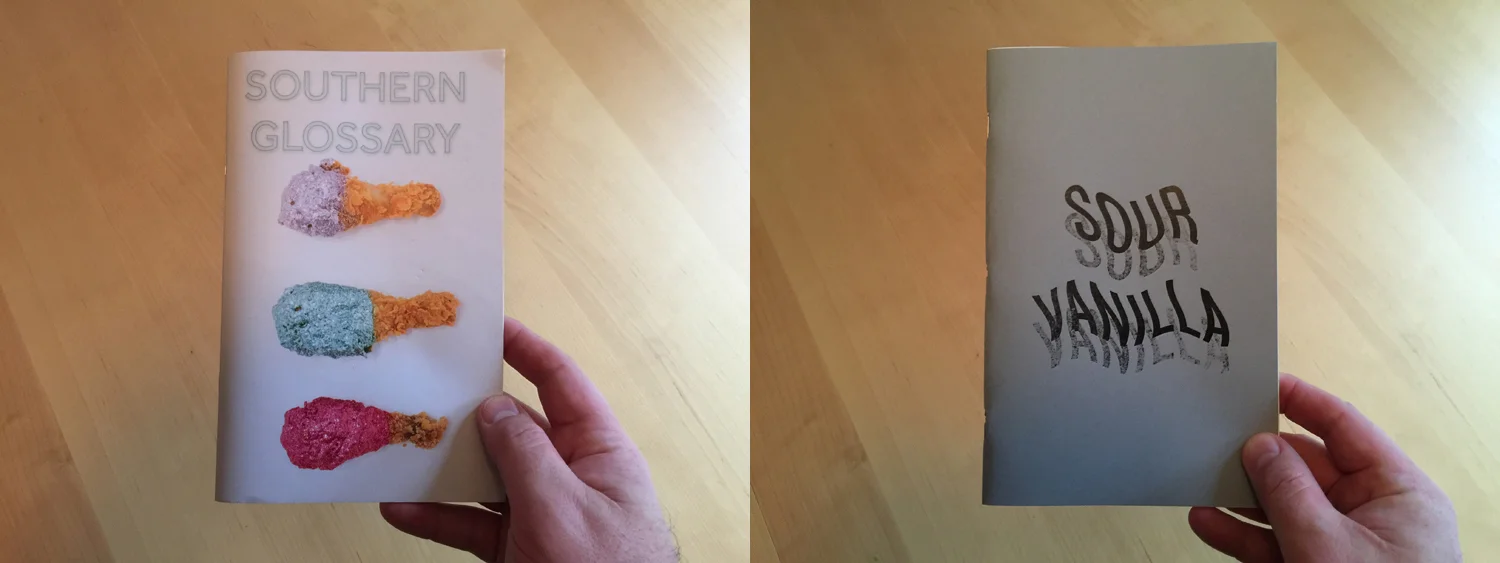
Southern Glossary | Ryan SparksSouthern Glossary, 2015, 60 pages. I was pleasantly surprised to get a copy of this in the mail from Ryan Sparks, the force behind Southern Glossary. A little over a year ago, Ryan featured the Looking at Appalachia project on Southern Glossary. In addition to several rounds of emails and a lengthy phone call about photography, writing, and publishing work, I knew Ryan was on to something wonderful. What I didn't know is that he'd produce such an amazing little zine of work from photographers and artists who'd contributed to the Southern Glossary Instagram feed over the past year. It features the work by Nic Persinger, Amanda Greene, Shaun H. Kelly, Jen Ervin, and many others along with a great essay - "Southern Identity Crisis" - by Brad Rhines. (Full disclosure: this zine was a gift and not a purchase.)
Sour Vanilla | Aaron CanipeAaron Canipe and Empty Stretch, 2015, 34 pages. Aaron's latest zine was another mailbox surprise received just a few days ago. I've spent quite a bit of time with it and I have to say it's quite something. As with all of Aaron's work I've seen in person, it's thoughtful, well-designed, and leaves me wanting more. Combined with Canipe's photos are text excerpts from Flannery O'Connor's "The Partridge Festival" (hence the title Sour Vanilla). "They sat silently, looking at nothing until finally they turned and looked at each other. There each saw at once the likeness of their kinsman and flinched." (Full disclosure: this zine was a gift and not a purchase.)