Native Tongue

If I go to hell, it won’t be because I didn’t accept Jesus. No, it’d be for the time I chose to talk differently, to give up my accent. I got saved more times than I can count, just in case the last time didn’t take. No, I reckon if I bust hell wide open, it’ll be because I traded my birthright, my native tongue, so they wouldn’t laugh. There are things in this world worse than the kind of hellfire and brimstone the Bible talks about, the kind those who are unfaithful deserve. There’s the kind of damnation that comes about from denying where you’re from, who you are.
I was 15 and they’d ask, “What color is that wall?” and I’d say, “It’s white,” but I’d say it with a few extra i’s in it and they’d all laugh. And I didn’t want the girls to laugh, so white with the extra i’s became white like the way everyone else in the city said it.
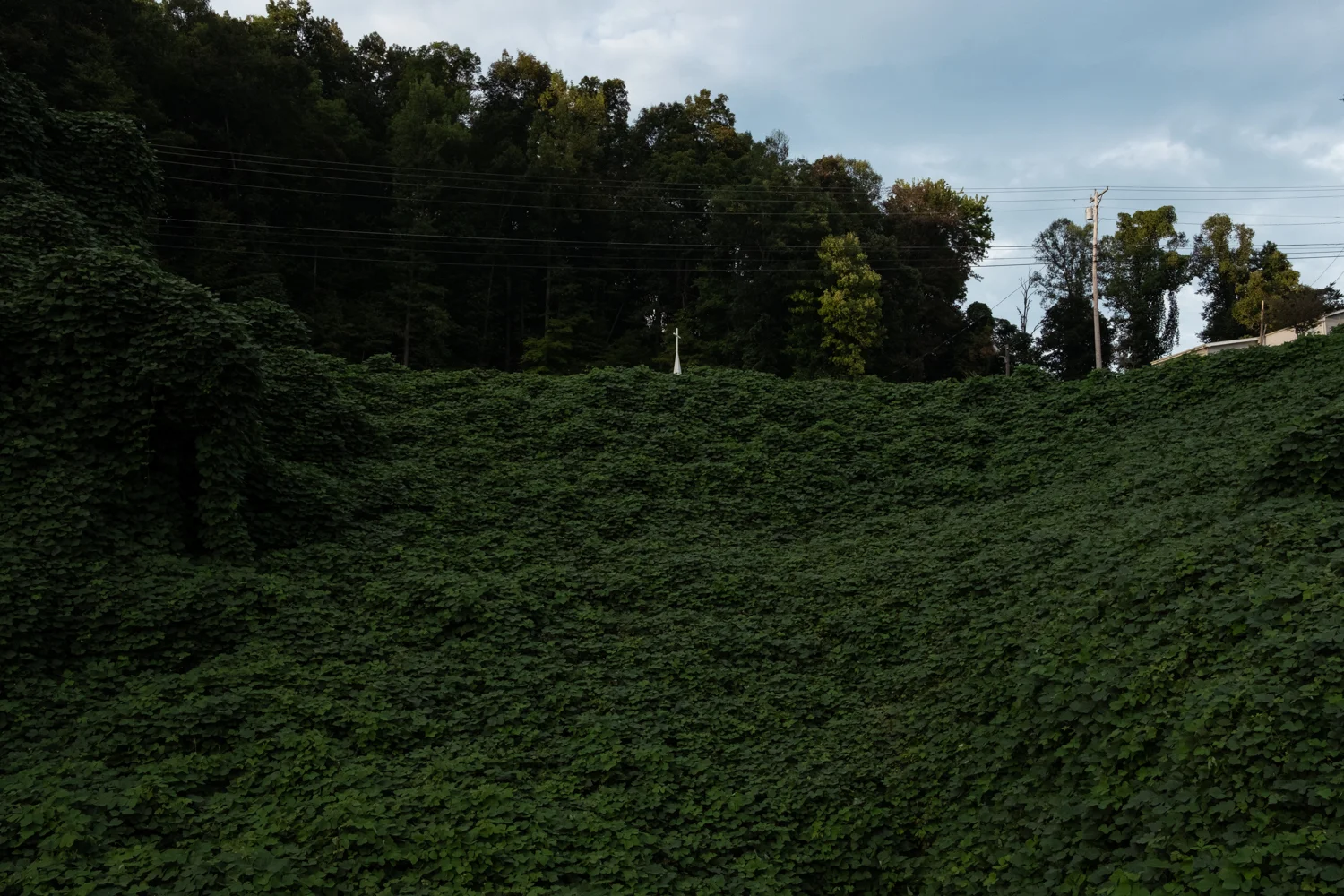
Even if you leave your faith behind, leave home behind, you can’t get away from the hills and the kudzu and steeples that dot and cover them. They are there as a reminder that, no matter what, you are anchored to home. The argument could be made that they’re both invasive species – the kudzu and the missionaries that brought religion to the mountains.
The kudzu and the church houses, they might be more forgiving than at first glance as you come and go and toil in the world. They both cover things we all once hoped for, believed in, or at least wanted to. They hide things in plain sight. They were both brought here as a solution to a problem and spread like wildfire. They each tell a story in their own way; tell it quietly and tell it shouting.
If I could go back, I’d tell that lanky mountain boy to hold on to that kind of talk, that the kudzu would listen – extra i’s and all.
Bell County, Kentucky (between Pineville and Middlesboro).
Review - William Gedney: Only the Lonely, 1955-1984
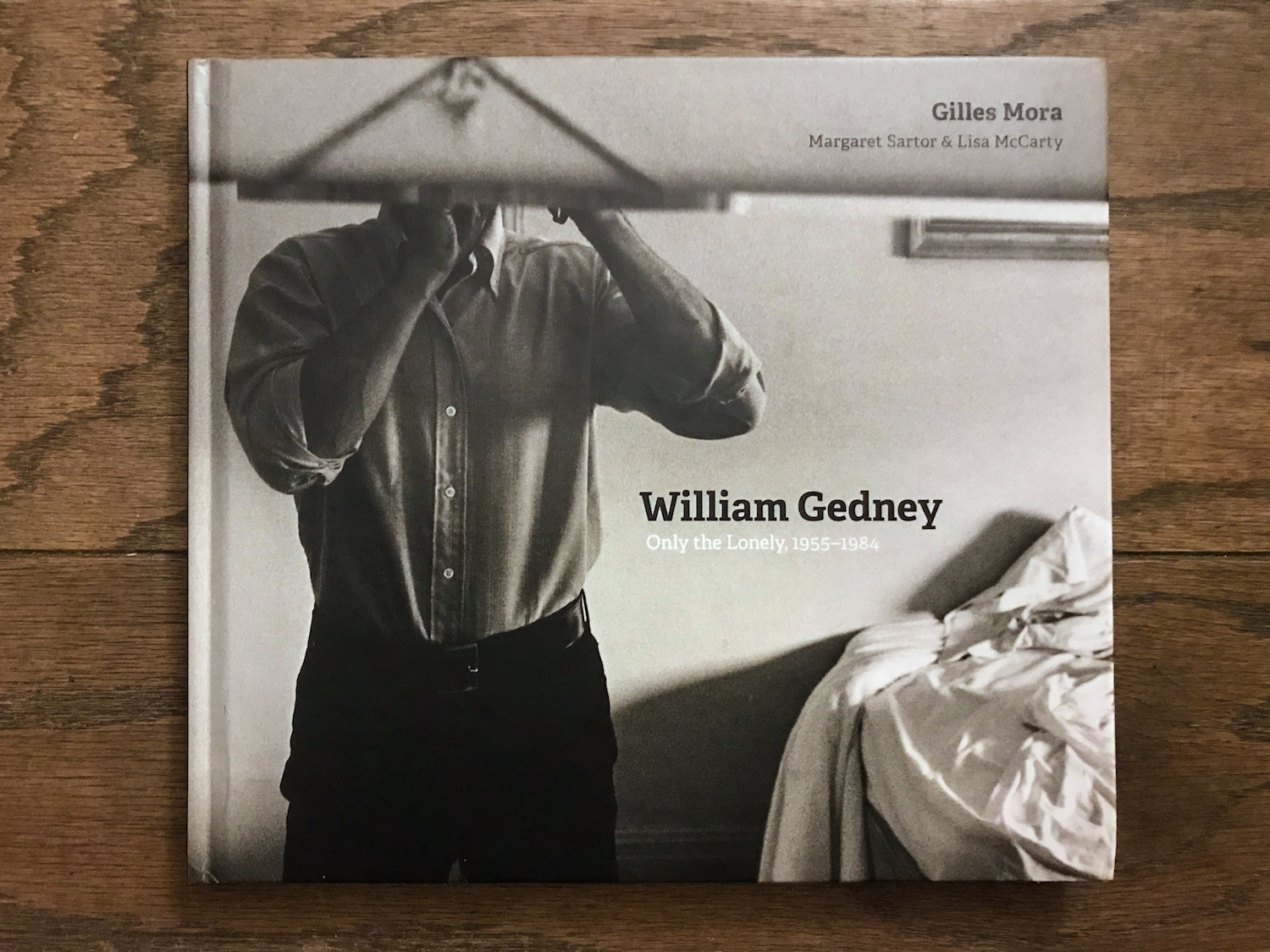
Hardcover | 10.5 x 9.5 inches | 160 pages | 160 duotone photographs | University of Texas Press, 2017 | Edited by Gilles Mora, Margaret Sartor, and Lisa McCarty
William Gedney’s work was once described as quiet poetry. I can’t think of a finer description of the photographer I’ve never met, but whose work has had a profound impact on my development as a photographer and understanding of photography in all its imperfections and limitations. Intimate is another word often used to describe his work, and although it truly is intimate, I worry that it has become something of a softball descriptor of work that is deeply complex and difficult to categorize. Only the Lonely provides us with a deeper dive into the expansive work of William Gedney. There are three distinct pieces of writing by the editors: “William Gedney, So Similar, So Different: Alone are the Lonely” (Gilles Mora), “Short Distances and Definite Places” (Margaret Sartor), and “Intimate Gestures: Handmade Books by William Gedney” (Lisa McCarty). The book is divided into eight sections of photographs: The Farm, 1955-1959, Brooklyn, 1955-1979, Kentucky, 1964, 1972, United States, 1964-1972, San Francisco, 1965-1967, India, 1969-1971 and 1980, Europe, 1974, and Gay Pride Parades, 1975-1983.
Only the Lonely, is the most recent significant work of this little known photographer. After his death in 1989, Gedney left the responsibility of his archive to Lee Friedlander, who has published dozens of books of his own work and is still actively making books, yet Gedney never lived to see his work in book form. Sean O’Hagan, who writes about photography for the Guardian, called Gedney a “pioneer of immersive documentary.” There has been somewhat of a resurgence in the work of William Gedney, for which I’m incredibly thankful. In 2013, photographer Alec Soth published Iris Garden, a beautiful book of Gedney’s pictures combined with the writing of John Cage (now out of print). Before that, only one other book had been published dedicated solely to the work of William Gedney. In 1993, Duke University became the repository for 51.3 linear feet of Gedney’s work. Margaret Sartor, a photographer, writer, and teacher at the Center for Documentary Studies at Duke, was approached by the library and asked to put together an exhibit of Gedney’s work. In 2000, Sartor and Geoff Dyer coedited What Was True: The Photographs and Notebooks of William Gedney (which quickly sold out and is also out of print).
William Gayle Gedney died on June 23, 1989 at the age 56. In his lifetime, he was awarded a John Simon Guggenheim Memorial Foundation Fellowship for photography (1966-67), a Fulbright Fellowship for photography in India (1969-71), a National Endowment for the Arts grant in photography (1975-76), and several other grants and fellowships. He had a show at the New York Museum of Modern Art (1968-69) as well as more than a dozen other exhibitions. I wrote about my desire for seeing Gedney’s Kentucky work come to fruition in book form exactly as he intended here.
In her essay “Short Distances and Definite Places,” Sartor writes of Gedney, “People trusted him. Moreover they trusted how he saw them.” This gets at the very heart of documentary and place-based work for me. It isn't enough to just earn the trust of folks who let you into their lives, although it is a critical and foundational step. Would that all of us in our documentary practice earn the trust of people to the extent that they trust how we see them. What a beautiful relationship to strive for and what a beautiful book to have as a reminder of its possibility.


Review - American Hollow

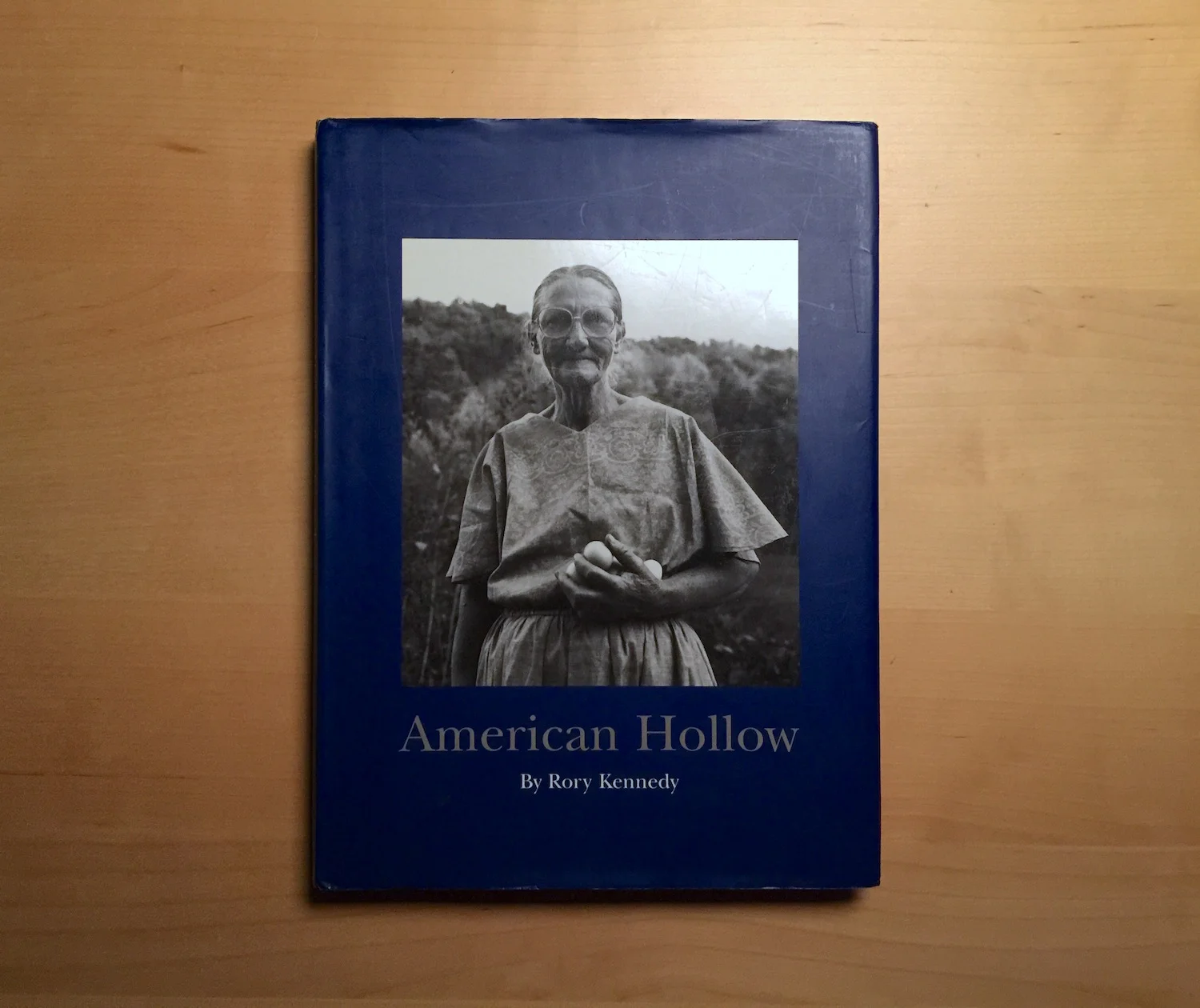
Hardcover| 8 x 11 inches | 144 pages | 128 black and white photographs | Bullfinch Press, 1999 | Rory Kennedy | $35
The Kennedy name is not an unfamiliar one in Appalachia. Brothers John and Bobby campaigned there, visits that were well documented and widely circulated. Bobby's son, Robert Jr., has been a longtime environmental advocate working to shed light on the destructive practice of surface mining. For this film (HBO) and companion book, his younger sister, Rory, spent a year off an on with the Bowling family of Saul, Kentucky in Perry County.
I struggle with both the film and the book (for example, constantly referring to the Bowling family as a clan, written twice in the dust jacket alone), but I'm convinced that's not necessarily a bad thing. The issues addressed - poverty, welfare, and violence to name a few - aren't as black and white as we'd all like them to be. They never are. And while I struggle with some of the framing of the story, even its very premise at times, it really asks us to consider the complexity of issues - and people - we tend to generalize and marginalize, intentionally or not.

(Bass [Bascum] at the supper table.)
Nearly every review I read of the film American Hollow used the word "hardscrabble." I can't tell you how much I hate that word as it seems to be perpetually used to describe life in Appalachia. There should be a drinking game designed around this. In fact, Kennedy's introduction to the book begins, "American Hollow is a many-textured story about a hardscrabble life of poverty in a beautiful and unspoiled landscape." Drink.
She continues, "We expect Appalachia to be a place of inbreeds and six-fingered children, of hillbillies and moonshine, an America more backwards than backwoods. But in my year with the Bowlings, I discovered that the truth is not so simple. Early on, the Bowlings and I forged a powerful connection. They immediately opened up their home to me, and I spent more time with them, I was struck by their sense of dignity and pride as they survived life in this forgotten corner of America." Yes, she went there.

(Lisa Raisor, age twelve, jumping.)
The book's foreword was written by Robert Coles, distinguished Harvard professor, Pulitzer Prize-winning author, and founding member of the Center for Documentary Studies at Duke University (as well as cofounder of DoubleTake Magazine with Alex Harris). Coles poignantly writes, "The further hope, of course, is that the rest of us take notice of Appalachia, that we become thereby connected in mind and heart to a people both proud and vulnerable, who at a distinct remove from us, even as they salute the same flag we honor, speak the same language we favor. Under such circumstances a nation lives up to its name." Coles describes working in Appalachia as a young physician, which seemed to leave a lasting impression.
Most of the film's focus is on the Bowling family matriarch, Iree. She is really something. She birthed and raised children (thirteen in all), cooked, cleaned, sewed, gardened, doctored, quilted, and did just about everything else that needed to be done on the family land. "I feel like I'm rich, rich as the Lord wants me to be," she declares. She has dedicated her entire life to preserving the old ways, the traditions, and worked to care for her family. Kennedy writes, "Ultimately, I think she knows that her way of life won't survive much longer."
As one might imagine, there is a clear distinction between American Hollow the film and American Hollow the book. It bothers me to no end that photographer Steve Lehman's name is absent from the cover. It is understandably Kennedy's film, but it is very much Lehman's book. As such, it's hard for me let go of this oversight. Without question, the book is beautifully printed and bound. I appreciate text-heavy photobooks when the text isn't merely ornamental; here it is instrumental. The interviews, conducted by Mark Bailey, are masterful and work well in concert with Lehman's photographs. One particular interview with Ivalene Estep (the third child of Iree and Bass), is especially moving. "I've been taking care of kids all my life...It's like this circle we all get in and we're afraid to get out," Estep shares. This could very well be my family.
You can pick up a copy of American Hollow for incredibly little money (as of this writing, I count at least eight copies for less than five dollars including shipping). As I mentioned earlier, I struggle with this book but feel it's a good addition to any collection. It's certainly worth your time to sit with and study a while.

(Iree and Lonzo.)
A couple of side notes:
I met director Rory Kennedy at the Full Frame Film Festival in Durham, North Carolina in 2010 after screening the film (and she signed my copy of American Hollow). A few months earlier, I photographed her brother, Robert Jr., at a debate with Don Blankenship, former Massey Energy CEO, in Charleston, West Virginia. I met two Kennedys in the span of four months.
The film can be seen in its entirety here.
For the first time, I've added a flip-through of the book I'm writing about (below). It's not the best quality as I'm not a videographer (as evidenced here), but I thought it would be nice to provide a more complete overview of the book, its pace, sequence, and design. We'll see how this one is received and if there's a demand, I'll add more. Thanks for looking.
Looking at Appalachia | Robert Gumpert
In 1972, while hitchhiking across the United States, Robert Gumpert found himself on the side of the road in Cabin Creek, West Virginia waiting for a ride. During a shift change at the coal mine nearby, seeing a steady stream of miners convinced him that he needed to come back to photograph the area.
Back in Los Angeles in late 1973, his conversation with the National Lawyer’s Guild connected him to Charleston, West Virginia. While there, he learned of an ongoing strike in Harlan County, Kentucky at the Brookside and Highsplint mines. At the same time, Barbara Koppel was making what would later become the well-known, Academy Award-winning documentary Harlan County U.S.A.

Last month, Gumpert was kind enough to participate in a Skype discussion about his experience making pictures in Appalachia as well as share some of his work.

For three months, Gumpert worked and lived in Harlan County photographing the strikes and the impact on the families and communities like Coxton and Evarts. All of this was happening not long after the killing of Canadian filmmaker Hugh O’Connor in neighboring Letcher County, which served as the centerpiece of Elizabeth Barret’s Stranger With a Camera.
Though this was Gumpert’s first major project, he was aware of the power of pictures and how they can be used to perpetuate stereotypes. A few times, Gumpert mentioned that newspaper reporters passing through the area asked for specific types of pictures, which he knew would be used to support an expected narrative about Appalachia. He flatly refused. However, he didn’t refuse to show poverty and hard times, he insisted on not making it the center of the story.
Back in Los Angeles, Gumpert began processing his film, making contact sheets, and selecting images for print. Working with a friend, Rick Fichter, who was a film major at USC, the project was broken down into three parts: the strike, inside the mines, and a family. He printed a show for a local bookstore intending to hang the photographs of the underground mine at approximately 29”, the height of the mine he visited. Realizing that most people wouldn’t make the effort to view the photos in that manner, he opted to mark the length of the wall at 29” to serve as a visual marker for the viewers.
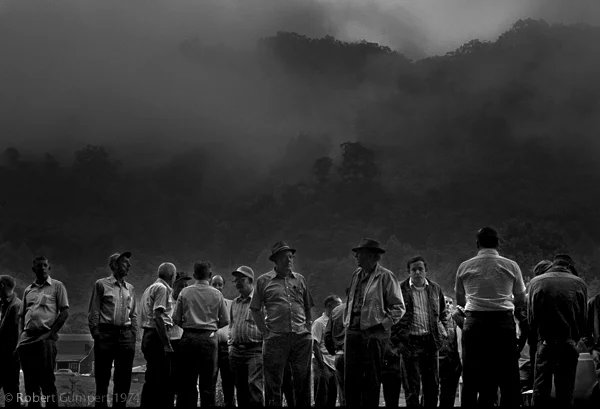
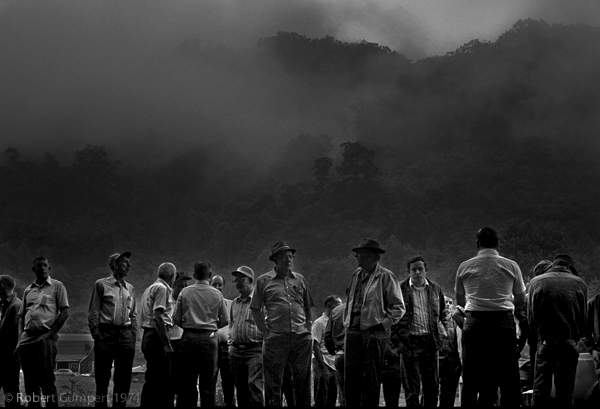
The work he did in Appalachia taught him a lot about exploitation. He sensed the bitterness and anger on the faces of the miners and families as day after day they watched absentee capitalism haul away their futures. This put a face on it for Gumpert. “I had my politics before I got to eastern Kentucky, but there was nothing like seeing it to bring it home for me.”






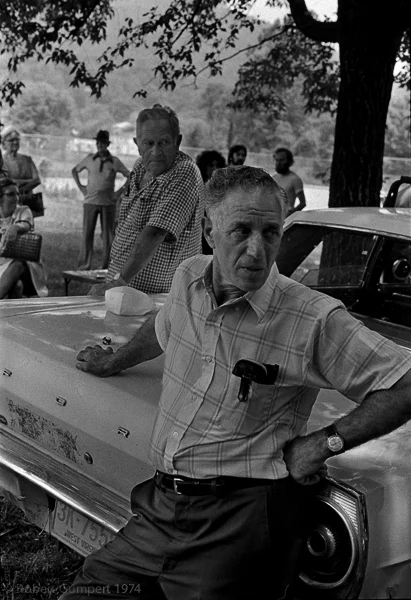


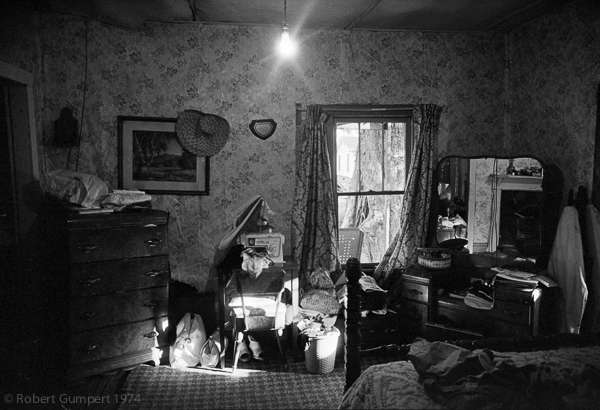


All photographs © Robert Gumpert, 1974 unless otherwise noted. All rights reserved.
1. Harlan County, Kentucky: Morning on the Highsplint picket line.
2. Screenshot of Skype conversation with Robert Gumpert, 10 July 2014. (Roger May)
3. Harlan County USA directed by Barbara Kopple. (Roger May)
4. Harlan County, Kentucky: Picket line at the Highsplint mine. The governor of Kentucky sent in the state police.
5. Harlan County, Kentucky: Basil Collins miner foreman and leader/manager of the scabs confronts picketers with a 45 in his right pocket.
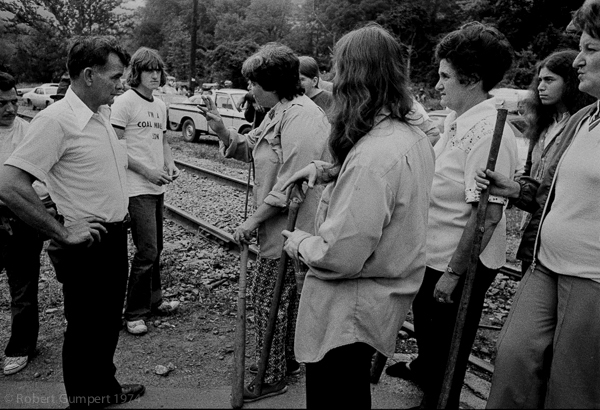
6. Harlan County, Kentucky: UMWA on a 13-month strike at Brookside mines and on the pick line at Highsplint mine. A meeting of the Brookside women's support group.
7. Harlan County, Kentucky: UMWA on a 13 month strike at Brookside mines and on the pick line at Highsplint mine. Women of the Brookside women's support group talk with Harlan County sheriff Billy Williams at a roadblock.
8. Harlan County, Kentucky: On the pick line at Highsplint mine.
9. Harlan County, Kentucky: Coal miners meet before heading to the picket line. Many local, small businesses supported the UMWA, the miners, and the strike.
10. Harlan County; Kentucky: Picket line at the Highsplint mine. The Kentucky governor sent in the state police and they proceeded to keep the strikers from blocking the scabs from working.
11. Harlan County, Kentucky: Scabs and gun thugs led by Basil Collins confront strikers on the pick line at Highsplint mine.
12. Coxton, Kentucky kitchen.
13. Harlan County, Kentucky: Highsplint picketers move to another mine.
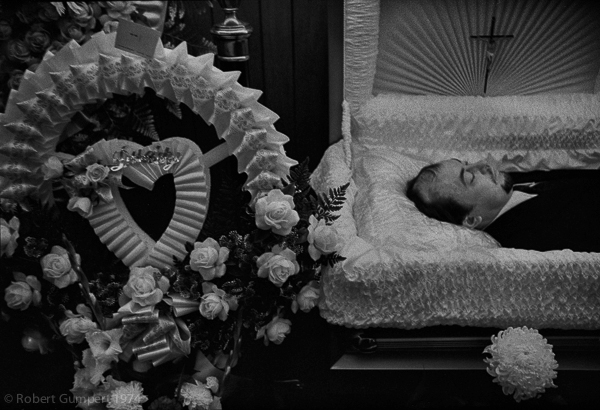
14. Harlan County, Kentucky: Funeral of Lawrence Jones, killed by a scab during a confrontation away from the picket line.
15. Harlan County, Kentucky: Funeral of Lawrence Jones, killed by a scab during a confrontation away from the picket line.
16. Harlan County, Kentucky: Funeral of Lawrence Jones, killed by a scab during a confrontation away from the picket line.
17. Harlan County, Kentucky: The wife and daughter of Lawrence Jones at his funeral. Mr. Jones was killed by a scab during a confrontation away from the picket line.
18. Retired miner at a Charleston, West Virginia rally for Harlan County, Kentucky strikers.
19. Charleston, West Virginia. Meeting of coal miners called by the United Mine Workers of America (UMWA).
20. Coal mining family at home just outside of Everts, Harlan County, Kentucky. After a 13-month strike, they won the right to have an election.
21. Harlan County, Kentucky: striking father Samson Blevins and his kids at home near Everts, Harlan County, Kentucky.
22. Coal mining family at home just outside of Everts, Harlan County, Kentucky. After a 13-month strike they won the right to have an election.
23. Harlan County, Kentucky: striking father Samson Blevins and child at home near Everts.
24. Coxton, Kentucky. Old miner with black lung and the breathing equipment he needs.
25. Harlan County, Kentucky: striking father Samson Blevins at home near Everts.
26. The Blevins family having a meal together at home. Samson Blevins, a coal truck driver, was on strike at the Highsplint mine.
27. Harlan County, Kentucky: Father and son in the Everts, Kentucky apartment above the Blevins family.
28. Harlan County, Kentucky: The Coxton, Kentucky home of a coal miner.
29. Harlan County, Kentucky: Family living upstairs from the Blevins, Everts, Kentucky.
30. 1974: Coal mining family at home just outside of Everts, Kentucky.
31. Harlan County, Kentucky: Coal mine, not on strike and not union, mining 29-inch coal seam.
32. Harlan County, Kentucky: Coal mine, not on strike and not union, mining 29-inch coal seam.
33. Brookside coal camp, early morning with the mine in the background. Harlan County, Kentucky.
34. Harlan County, Kentucky: Victory photo after the miners of the Highsplint mine voted to join the UMWA.